Treating Generative AI Not as Software, But as an Employee with a Corporate Card.
AI Agent Governance
The Executive Problem: The “Steve” Analogy
Imagine you hired an intern named Steve.
You give Steve a corporate credit card with no limit. You tell him, “Steve, go research the best color for our new website button.” Then, you leave for the weekend.
When you return on Monday, you find that Steve has spent $5,000.
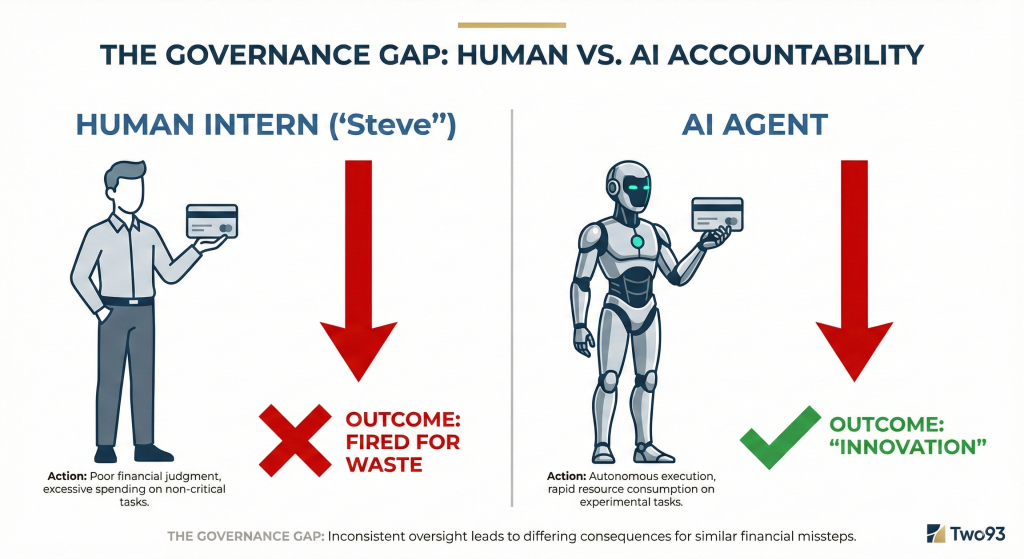
He didn’t steal the money. He just spent 48 hours running a focus group of 10,000 people to determine that the best color is… Blue.
Steve was diligent. He was hardworking. He was also a financial disaster.
If Steve were a human, you would fire him immediately.
But when an AI Agent does this—spinning in an infinite loop, burning GPU credits to solve a trivial problem—we call it “Innovation.” We put it on a slide deck.
It is time to stop treating AI Agents like “Software” (a fixed subscription) and start treating them like “Contingent Labor” (a variable cost).
This paper proposes a new framework for IT Leaders: Applying traditional Vendor Management discipline—SOWs, Rate Cards, and Performance Reviews—to your digital workforce.
1. AI Agent Governance – The Category Error: It’s Not SaaS, It’s OPEX
For the last decade, CIOs have managed software spend via “Seats” or “Licenses.” You buy a Salesforce seat for $150/month, and the cost is capped.

AI Agents break this model. They are consumption-based. They are closer to a contractor billing hourly than a software license.
- The Risk: A human contractor has to sleep. An AI Agent can run 24/7/365, making API calls every millisecond. The potential for “runaway spend” is not linear; it is exponential.
- The Fix: We must move AI Governance out of “Software Procurement” and into “Contingent Workforce Management.” Every Agent needs a contract.
2. AI Agent Governance – The Solution: The “Digital SOW” Framework
We need to enforce three specific controls on every AI Agent deployment. These are not just policies; they are Engineering Features.
Control A: The Financial Circuit Breaker (The “NTE”)
In traditional Vendor Management Contracts, Time & Material contracts have a Not-To-Exceed (NTE) clause. Setting a maximum budget limit for a project or service, protecting clients from cost overruns. It acts as a crucial financial safeguard, ensuring costs stay within agreed-upon limits without needing constant renegotiation for minor variances, but demanding formal changes for significant overruns. Organizations also have a whole department or governance in place to manage financials for IT Contracts.
Your Agents need the same.
Most developers implement “Error Handling” (what happens if the code crashes). They rarely implement “Cost Handling” (what happens if the code gets expensive).
The Engineering Constraint:
We must implement “Middleware” that sits between the Agent and the LLM provider. This middleware acts as the frantic manager watching the budget.
- The Rule: “If this single session exceeds $2.00 in API costs, CUT THE CONNECTION and request human approval.”
- The Result: You cap your downside risk. The most you can ever lose on a “runaway agent” is the cost of a cup of coffee.
Control B: Labor Arbitrage (The “Rate Card”)
You wouldn’t hire a Principal Cloud Architect ($300/hr) to summarize meeting notes. Yet, enterprises routinely use “Reasoning Models” (like GPT-4o or Gemini 1.5 Pro) for basic text formatting. This is an obscene misuse of capital.
The Engineering Constraint:
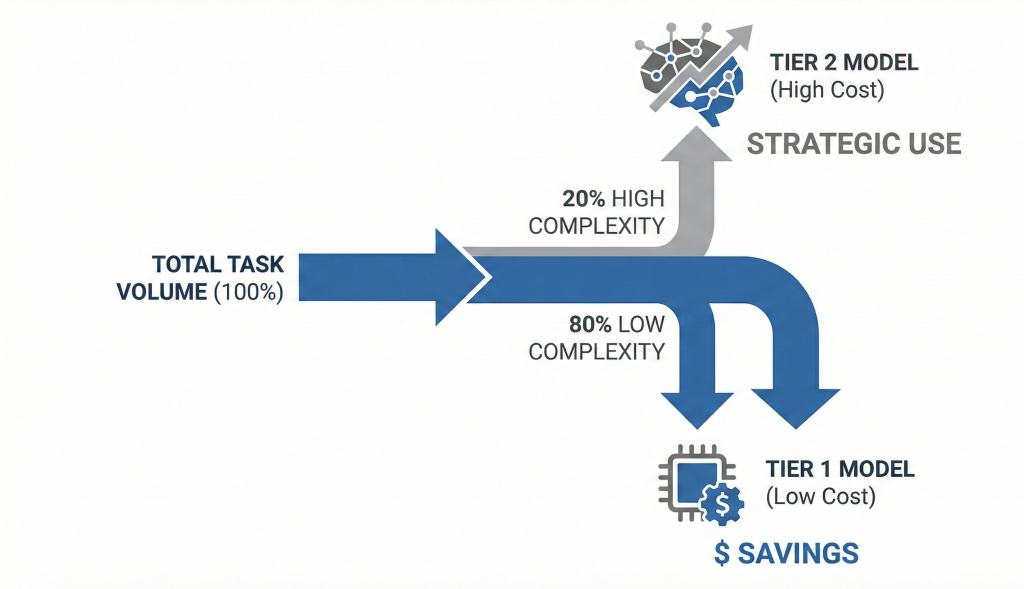
We need Model Routing (Digital Labor Arbitrage).
- Tier 1 Labor (The Intern): Default all tasks to “Flash” or “Haiku” models. These are cheap, fast, and good enough for 80% of work.
- Tier 2 Labor (The Expert): Only allow the Agent to access “Reasoning” models if the Tier 1 model fails or flags the task as “High Complexity.”
- The Result: You lower your blended cost basis by 60-80% without sacrificing quality.
Control C: The “Zombie” Clause (Scope Definition)
Agents often get stuck in loops, trying to fix a bug, failing, and retrying 100 times. We call these “Zombie Agents.” They are dead, but they are still eating your budget.
The Engineering Constraint:
- Max Retry Limit: Hard-code a limit of 3 attempts. If the Agent can’t solve it in 3 tries, it must stop.
- Forbidden Zones: Explicitly define what the Agent cannot do. (e.g., “This Agent is contractually forbidden from spinning up new cloud infrastructure”).
3. AI Agent Governance – The New KPI: Cost Per Outcome
Finally, we must change how we measure success.
Currently, most engineering teams track “Cost Per Token.” This is a vanity metric. It is like tracking “Cost Per Keystroke” for a human writer. It tells you nothing about value.
The Shift: Move to “Cost Per Successful Commit.”
- If Agent A costs $0.10/run but fails 50% of the time, its real cost is $0.20 per outcome.
- If Agent B costs $0.15/run but succeeds 100% of the time, Agent B is cheaper.
The PIP (Performance Improvement Plan):
If an Agent’s “Success Rate” drops below 80%, it goes on an automated PIP. Its permissions are revoked until a human developer reviews its prompt logic. Stop paying for incompetent digital labor.
Conclusion: The Future of the Vendor Manager
The role of IT Vendor Management is shifting. They are no longer just negotiating with Infosys, Accenture, or Microsoft. They are managing a workforce with a fleet of 10,000 autonomous digital workers.
The names on the invoices will change, but the discipline remains the same.
You need a Contract. You need a Budget. And you need the ability to fire the underperformers.Don’t let your digital interns bankrupt your department
FAQ:
- Q: What is a Digital SOW for AI?
- A: A Digital Statement of Work (SOW) is a governance framework proposed by Two93 Consulting that applies financial circuit breakers (NTEs) and operational boundaries to autonomous AI Agents to prevent cost overruns.
- Q: What is a Zombie Agent?
- A: A “Zombie Agent” is an AI process that gets stuck in an infinite loop, consuming API credits and cloud budget without producing a successful outcome or deliverables.
- Q: How do you control AI Agent costs?
- A: By implementing “Middleware” proxies that enforce rate limits, using Model Routing (Labor Arbitrage) to switch between cheap and expensive models, and setting strict “Retry Limits” for error handling.