
Why US Leaders Must Rethink “Static Pricing” in a Depreciating Rupee Environment
TL/DR
The Problem Most US-based IT outsourcing contracts are denominated in US Dollars, while delivery costs are incurred in Indian Rupees. As the Rupee depreciates, vendors enjoy an automatic “margin windfall”—a silent transfer of value that many US executives fail to capture.
The Reality While vendors argue that wage inflation erodes these gains, the math often reveals a net surplus. For Global Capability Centers (GCCs), this shift creates immediate budget surpluses; for third-party relationships, it creates a crucial negotiation leverage point.
The Solution Leaders must abandon static pricing models in favor of dynamic adjustments. Implementing FOREX collars, using currency gains to offset COLA requests, and establishing innovation funds are the primary levers to reclaim this value.
For the last decade, the IT outsourcing narrative has focused heavily on labor arbitrage—the wage differential between a developer in Bangalore and one in Boston. But as the US Dollar strengthens against the Indian Rupee (moving from ₹83 to ₹90 and beyond), a second, often overlooked form of arbitrage has emerged: Currency Margin Expansion.
For US-based CIOs and sourcing leaders, the objective reality is stark. Your vendor’s cost of delivery is decreasing in dollar terms, yet your price likely remains static. This decoupling of price from cost creates a “margin windfall” for vendors—one that standard fixed-price contracts effectively hide.
To manage this, leaders must understand the underlying economic mechanic, the divergent impacts on vendors versus captives, and the specific contractual levers available to recapture value.
The Economic Mechanic: Where the Value Goes
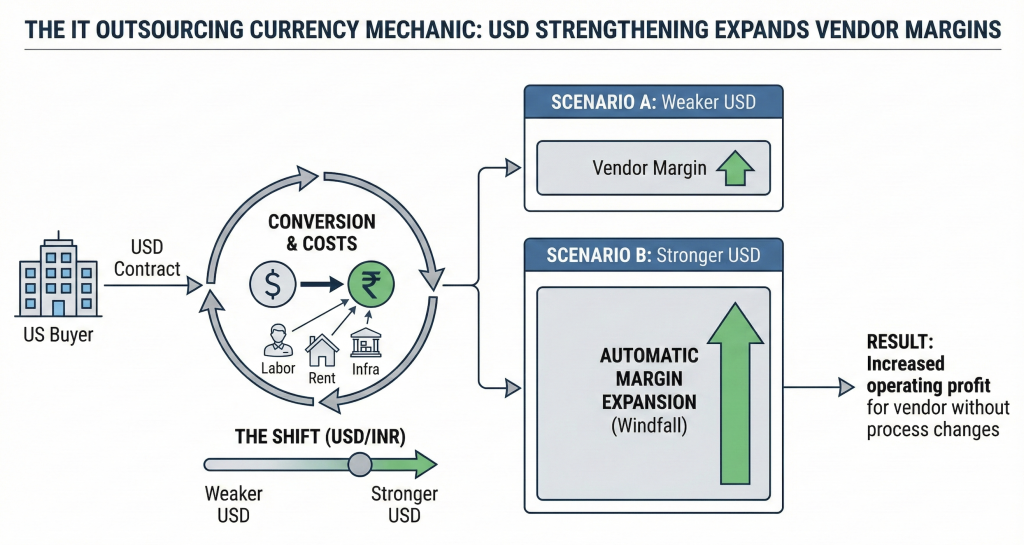
The mechanics of this value transfer are simple but potent. Consider a standard Managed Services contract where you pay a vendor $100.
- The Revenue Side: Your payment is fixed in USD.
- The Cost Side: The vendor converts that $100 into INR to cover local expenses—salaries, infrastructure, and rent.
- The Shift: As the Rupee depreciates, your $100 buys significantly more local currency.
If a vendor operates on a 20% margin at ₹83 to the dollar, a shift to ₹88 can expand that margin to 23-25%—without a single operational improvement. In this scenario, the vendor is not just profiting from service delivery; they are profiting from currency speculation, with you as the unwitting financier.
The Impact: A Tale of Two Models
The strategic implication of this shift depends entirely on your sourcing model. As illustrated below, the currency windfall is hidden in a third-party relationship but creates a direct budget surplus in a captive model.
1. Third-Party Outsourcing (The “Tailwind” Effect) For major integrators (e.g., TCS, Infosys, Wipro), a strengthening dollar is a significant financial tailwind. It naturally boosts Earnings Per Share (EPS) and provides a buffer against operational inefficiencies.
- The Vendor Argument: When pressed, vendors will claim that high attrition and wage inflation in India (often hovering between 8-12%) consume these currency gains.
- The Buyer Reality: This is the primary battleground. While inflation is real, it rarely correlates perfectly with currency devaluation. Often, the currency gain outpaces the inflation “bite,” leaving a net surplus that the vendor pockets as pure profit.
2. Global Capability Centers (The “Budget Surplus”) For leaders managing a GCC or captive unit, the impact is immediate and positive. Because the US parent funds the GCC as a cost center, a stronger dollar reduces the effective Operating Expense (OpEx) of the center.
- The Opportunity: This creates a “found money” dynamic. Forward-thinking leaders are not returning this surplus to the corporate treasury; they are reinvesting it. This capital is being diverted to fund “Change” initiatives—AI pilots, automation, and upskilling programs—that effectively cost the enterprise nothing in net-new budget.
Strategic Levers: Moving to Dynamic Adjustments
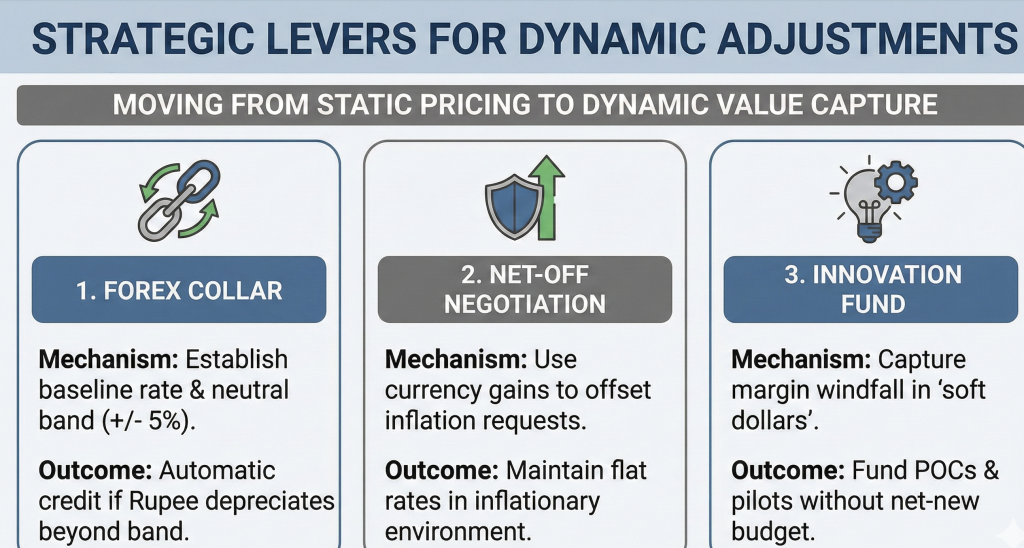
To address this imbalance, US leadership must transition from static pricing to dynamic contract structures. Three specific levers can restore equilibrium.
1. The “FOREX Collar” The era of the flat 5-year rate card is over. Sophisticated contracts now include a Currency Fluctuation Clause, or “Collar.”
- How It Works: Establish a baseline exchange rate (e.g., ₹85 = $1) and a neutral band (e.g., +/- 5%).
- The Trigger: As long as the rate fluctuates within the band (₹80.75 – ₹89.25), prices remain stable. However, if the Rupee depreciates beyond the upper limit (e.g., to ₹92), the contract triggers an automatic credit or rate reduction, ensuring the vendor passes a percentage of that windfall back to the buyer.
2. The “Net-Off” Negotiation Strategy Vendors frequently approach renewal cycles with requests for Cost of Living Adjustments (COLA) or inflation-based rate hikes. This strategy is visualized below.
- The Counter-Move: Use currency data as a shield. The argument is mathematical: “You are requesting a 5% inflation hike, but the Rupee has depreciated 6% against the Dollar. Your effective cost basis in USD has actually dropped. We will therefore ‘net off’ the inflation request against the currency gain.”
- The Goal: In an inflationary environment, maintaining a flat rate is a strategic win.
3. Gain-Sharing for Innovation If hard-dollar rate reductions are contractually difficult to enforce mid-term, pivot to “soft dollar” value capture.
- The Mechanism: Calculate the margin expansion (e.g., ~200 basis points) and require the vendor to deposit an equivalent value into an “Innovation Fund.”
- The Usage: This fund finances Proof of Concepts (POCs) or consulting hours that would otherwise be billable, effectively allowing the exchange rate to subsidize your R&D.
Conclusion
Currency fluctuation is often treated as a macro-economic abstraction, but in IT outsourcing, it is a tangible line item. For vendors, it is a silent margin booster. For unprepared buyers, it is a leakage of value.
The task for US leadership is not to become forex traders, but to ensure that their contracts reflect economic reality. By implementing collars and leveraging currency data in negotiations, executives can ensure that the value of a stronger dollar accrues to the enterprise that earned it.