Why Headcount and Utilization No Longer Reflect Value Creation
Executive Summary
For decades, Global Capability Centers (GCCs) have been evaluated using a stable set of operational metrics—headcount, utilization, and cost per FTE. These measures provided a reliable proxy for productivity in a labor-driven delivery model.
However, the rapid integration of artificial intelligence into enterprise workflows has fundamentally altered how work is executed. Today, outcomes are increasingly produced through a combination of human expertise and machine-driven cognition. As a result, traditional metrics no longer capture true performance—and in many cases, they actively distort it.
IT leaders must now transition from labor-centric measurement frameworks to models grounded in consumption, outcomes, and automation leverage.
The Limits of Traditional Metrics

Historically, GCC performance has been anchored in two primary indicators:
- Headcount growth as a signal of scaling capability
- Utilization rates as a measure of efficiency
These metrics were effective in environments where output correlated directly with human effort. More people, working at higher utilization, generally translated into more work delivered.
In an AI-enabled operating model, that relationship no longer holds.
A software engineer augmented with AI tools may complete tasks in a fraction of the time previously required. From a traditional lens, this appears as underutilization. From a business perspective, it is a significant productivity gain.
This disconnect creates a critical issue: organizations risk penalizing efficiency while rewarding activity.
The Emergence of a Hybrid Workforce

Modern GCCs are no longer purely human systems. They are hybrid environments composed of:
- Skilled engineers and domain experts
- AI copilots and autonomous agents
- APIs and model-driven workflows
- Underlying compute and token-based consumption
Despite this shift, most reporting structures continue to reflect only the human component of delivery.
This creates a visibility gap. Leaders are effectively managing a system where a growing share of the work—and cost—is invisible to traditional metrics.
The implication is clear: what is not measured cannot be governed.
From Labor Economics to Consumption Economics
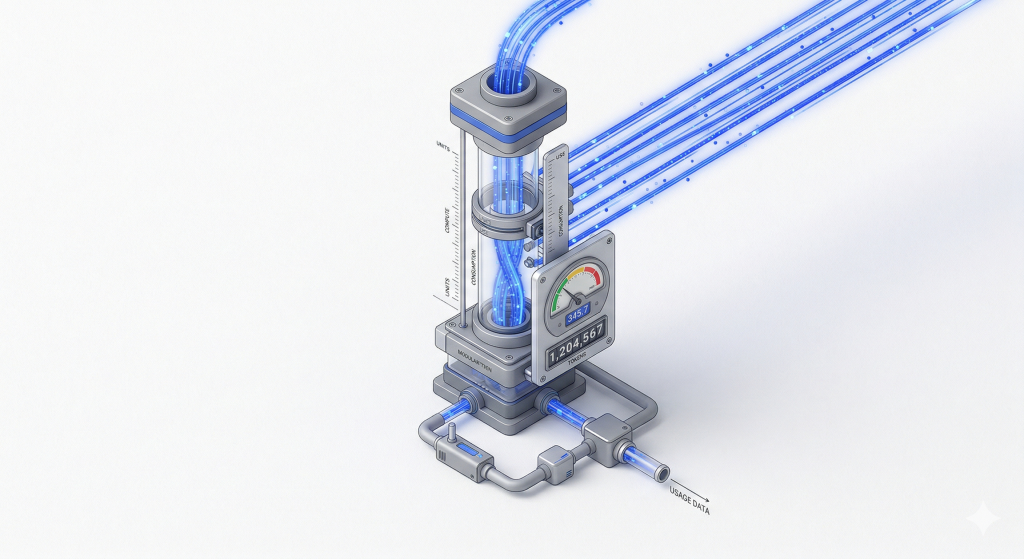
The introduction of AI transforms the economic model of GCCs. Instead of being driven primarily by labor costs, delivery is increasingly influenced by consumption of computational resources and model interactions.
This shift mirrors the earlier transition from on-premise infrastructure to cloud computing. Organizations that continued to measure performance based on server counts struggled to manage cost and scale effectively. The same risk now applies to AI-enabled delivery.
A modern GCC must therefore evolve its measurement framework:
| Traditional Metrics | Emerging Metrics |
| Cost per FTE | Cost per outcome |
| Utilization (%) | Cycle time per outcome |
| Headcount growth | Automation coverage (%) |
| Hours worked | Compute/token consumption |
| Pyramid structure | Human-to-AI leverage ratio |
This is not simply a refinement of existing metrics—it is a redefinition of what constitutes productivity.
The Risks of Misaligned Measurement

Organizations that fail to evolve their metrics face three immediate risks:
1. Financial Opacity
AI introduces a new cost layer—often variable and consumption-based—that is not reflected in traditional reporting. This can lead to underestimation of true delivery costs and budget drift.
2. Distorted Incentives
When utilization remains a primary metric, employees who automate their work may appear less productive. Over time, this discourages innovation and reinforces inefficient behaviors.
3. Limited Vendor Transparency
Many outsourcing partners are already leveraging AI internally. Without updated measurement and contractual frameworks, enterprises lack visibility into how work is performed and how costs are incurred.
In each case, the organization loses alignment between effort, cost, and value delivered.
What IT Leaders Should Measure Now
To operate effectively in an AI-enabled environment, IT leaders should prioritize a new set of performance indicators:
Cost per Outcome
Measure the cost of delivering a specific business result (e.g., resolving a ticket, deploying a feature). This aligns financial metrics with value creation.
Cycle Time
Track the time required to complete a task or workflow. Speed becomes a more meaningful indicator of performance than hours worked.
Automation Coverage
Understand what percentage of workflows are fully automated, partially automated, or require human intervention. This provides a clear view of operational maturity.
Consumption Metrics
Monitor token usage, model calls, and compute consumption associated with delivery. This introduces transparency into the new cost structure.
Human-to-AI Leverage
Assess how effectively human talent is amplified by AI. This reflects the true scaling capability of the organization.
Implications for Operating Model Design
Adopting new metrics is not a reporting exercise—it requires a broader shift in operating model:
- Instrumentation: Systems must be designed to capture consumption data at a granular level
- Governance: AI usage must be auditable and aligned with financial controls
- Incentives: Performance management should reward efficiency, automation, and outcomes
- Vendor Management: Contracts should evolve to include outcome-based pricing and transparency into AI-driven delivery
Without these changes, measurement improvements will not translate into better decision-making.
A Defining Moment for GCC Leadership
The transition to AI-enabled delivery represents a structural shift comparable to the adoption of cloud computing. In both cases, organizations that adapted their measurement and governance models early were able to capture disproportionate value.
Those that did not faced cost overruns, operational inefficiencies, and strategic drift.
Today, GCC leaders are at a similar inflection point.
Conclusion

Headcount and utilization were effective metrics for a labor-driven era. In an AI-enabled environment, they are no longer sufficient—and may, in fact, be counterproductive.
The future of GCC performance management lies in measuring outcomes, understanding consumption, and optimizing human–AI collaboration.
For IT leaders, the mandate is clear:
Shift the focus from managing activity to managing value.
Organizations that make this transition will not only improve efficiency—they will redefine how capability centers create strategic advantage in the enterprise.