
“In a world where AI can autocomplete your thoughts, the real skill is remembering how to think for yourself.”
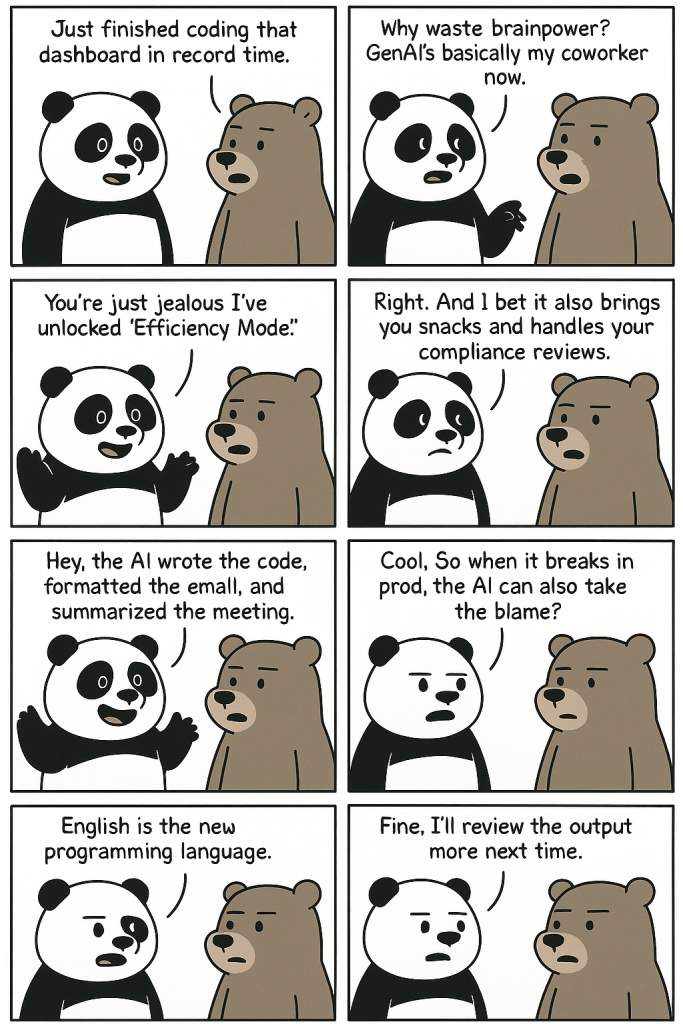
Remember when writing code meant staring at a whiteboard, breaking down logic like a modern-day Sherlock, and engaging in five-hour debates about whether to use tabs or spaces? Yeah. Now we’re speed-prompting GPT like it’s a vending machine for dev solutions.
A recent study from Carnegie Mellon and Microsoft Research, The Impact of Generative AI on Critical Thinking, reveals what many in IT may have suspected but quietly ignored: as GenAI becomes the intern, tutor, and co-pilot, we’re losing more than just keystrokes — we’re losing our edge. And that’s a problem, especially for teams building software, architecting systems, or making decisions in the cloud-and-AI-first enterprise world. https://www.microsoft.com/en-us/research/wp-content/uploads/2025/01/lee_2025_ai_critical_thinking_survey.pdf
Let’s break it down, minus the academic fluff.
⚠️ GenAI is Great—Until It Becomes a Crutch
The study surveyed 319 knowledge workers and found something telling:
People with high confidence in AI tools were less likely to engage in critical thinking. On the flip side, those confident in their own abilities were more likely to think critically when using GenAI.
Translation for dev teams:
If you’re leaning on GenAI for every line of code, design doc, or vendor email, you may be outsourcing your judgment. You’re still responsible when that shortcut turns into a production incident at 2 a.m.
🛠️ IT Workflows Need Brains, Not Just Bots
Whether you’re debugging code, vetting SaaS vendors, or reviewing infrastructure changes, your job is about more than output. It’s about understanding. GenAI can churn out five paragraphs or 50 lines of code, but it can’t:
- Understand business context
- Apply nuanced logic in chaotic, real-world scenarios
- Foresee the long-term maintainability of “working” code
As the study notes, users who simply accept AI’s output without tweaking or verifying it may feel efficient—but they’re skipping the heavy lifting that makes them better engineers, architects, or analysts.
🧩 English May Be the New Programming Language, But Logic Is Still the Compiler
One of the biggest myths floating around AI-assisted development is this: “You don’t need to think deeply if you can prompt well.”
That’s like saying, “You don’t need to understand cars to drive a Tesla.” Sure, until you’re stranded on the highway with a warning light blinking and no mechanic in sight.
Prompting isn’t thinking. It’s the setup. The real skill lies in evaluating, editing, integrating — and yes, pushing back. As the researchers found, critical thinking often now manifests as verifying, reframing, and editing AI output. It’s not gone — it’s just shape-shifted.
👎 Less Thinking Today = More Tech Debt Tomorrow
Let’s get real: skipping the thinking part may save you time this sprint, but you’ll pay interest on that cognitive debt.
Think poor architectural decisions, spaghetti code in disguise, or vendor contracts written with hallucinated clauses.
The study’s warning is clear: long-term overreliance weakens your ability to problem-solve independently. Think of it as muscle atrophy for the mind. And if you’re only flexing your brain when things break? You’re in for a rude awakening.
🔁 So What Should Teams Do?
- Bake in “Reflection Loops”
Don’t just review AI output. Challenge it. Make “why is this the best approach?” a standard part of your team culture. - Keep Hands on the Wheel
GenAI is a co-pilot, not autopilot. Don’t let “good enough” AI output pass as final work without your brain in the loop. - Reward Thinking, Not Just Speed
Stop fetishizing “faster” and start appreciating “smarter.” Quality review > quantity of commits. - Sharpen Skills Regularly
Run exercises without AI. Make your devs solve a problem cold once in a while. It’s CrossFit for critical thinking.
🧠 Bottom Line: Don’t Be the Human Rubber Stamp
GenAI is powerful. It’s efficient. It’s also a little too confident in itself (and so are some users). If IT teams want to thrive in this AI age, the answer isn’t less thinking — it’s better thinking.
So go ahead, prompt your way to a prototype.
But don’t forget to pause, poke holes, and push back — because “works on my machine” won’t cut it when your brain is the real system under test.



Remember the days when coding was an art form, a puzzle to solve with patience and precision? Now, it feels like we’re just feeding prompts into a machine and hoping for the best. While AI can generate code or text in seconds, it’s no substitute for the critical thinking and understanding that make us skilled professionals. Relying solely on AI might save time, but it risks creating a generation of engineers who can’t troubleshoot or innovate. The analogy about driving a Tesla without understanding cars is spot on—what happens when things go wrong? Do we risk building systems that look functional but are fundamentally flawed? How do we strike the balance between leveraging AI and maintaining our expertise? Would love to hear your thoughts on this—are we trading efficiency for competence?