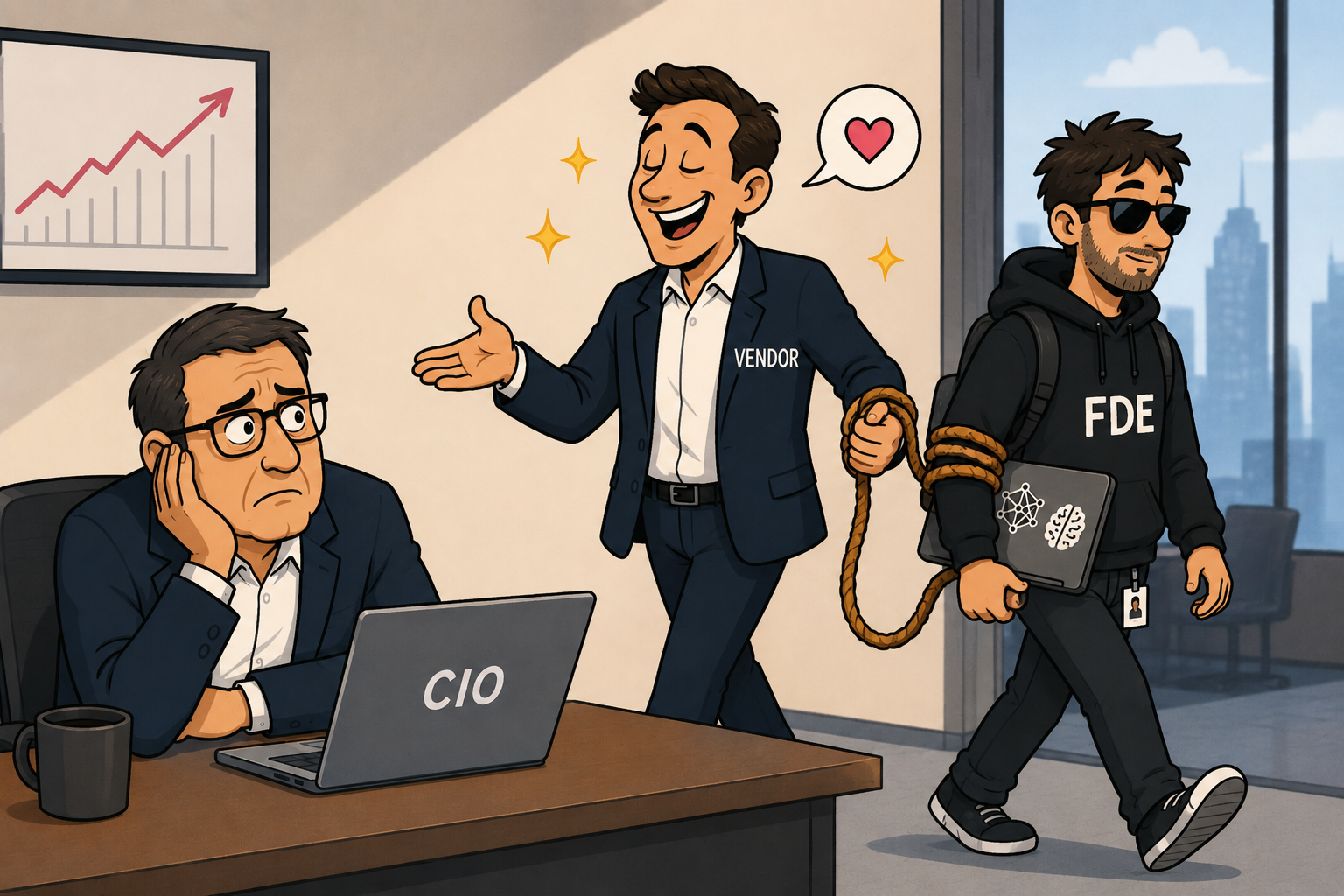
Last year, enterprise technology leaders were frantic to hire prompt engineers. This year, the goalposts have shifted entirely. As foundational model providers and enterprise AI platforms realize that enterprise software doesn’t deploy itself out of a box, they are leaning heavily into a different delivery vehicle: Forward Deployed Engineering (FDE).
From OpenAI and Anthropic to Palantir and Databricks, the FDE model has quickly become the premium standard for enterprise AI implementation. The pitch is incredibly seductive to a CIO: “We won’t just drop an API key on you. We will embed a highly specialized, elite AI engineer directly into your workflows for six to twelve months to build custom production-ready integrations on top of your data.”
To an enterprise struggling with limited internal AI talent, this sounds like a lifeline. But to a technology procurement and vendor management leader, the rise of the AI FDE represents a massive structural risk—one that blurs the lines between SaaS, professional services, and high-stakes vendor lock-in.
The Illusion of the Software Line Item
For decades, vendor management offices (VMOs) have successfully kept software licensing and professional services in separate buckets. Software scales gracefully with high margins; professional services represent human headcount and variable execution risk.
The FDE model completely breaks this taxonomy. When an AI vendor includes a team of FDEs to close a multi-million dollar commitment, how are you actually pricing the asset?
If the underlying AI model requires hundreds of hours of manual, on-site engineering adjustments just to map your data schemas or handle compliance guardrails, you aren’t buying mature software.
You are funding the vendor’s product R&D.
The FDEs are essentially field-testing their product’s edge cases on your infrastructure. If their success is defined by what they “learn and return” to their product headquarters, you are paying a premium to act as their beta-testing lab.
Three Governance Pitfalls of the Embedded FDE
Before signing off on an enterprise AI contract anchored by an FDE delivery model, vendor governance teams must address three structural realities:
1. The Headcount Scalability Mirage
The primary warning sign of a brittle technology architecture is a vendor relationship that only scales by adding human bodies. If every new enterprise use case requires another FDE to embed with your team, you have not escaped legacy labor arbitrage—you have simply traded offshore IT consultants for million-dollar Silicon Valley engineers. True software leverage should make subsequent deployments cheaper, not more human-dependent.
2. Intellectual Property Contamination
FDEs operate in an ambiguous grey area. They sit in your internal standups, write production code inside your environment, and manipulate your proprietary datasets. If an FDE builds a custom orchestration layer or an innovative Retrieval-Augmented Generation (RAG) framework to solve your specific insurance or financial workflows, who owns that logic? If the FDE’s core mandate is to codify field learnings back into the vendor’s platform layer, your unique operational competitive advantage could easily end up shipped to your competitors in the next global model update.
3. The Off-Ramp Problem
What happens when the 12-month embedding period ends and the FDEs pack up to leave? Because these engineers operate at a high velocity—frequently bypassing standard internal ITIL frameworks to move fast—they often leave behind highly complex, undocumented custom data plumbing. If your internal engineering team lacks the technical capability to maintain a bespoke frontier-model pipeline, the end of the engagement creates immediate operational risk, forcing a costly contract extension.
Rewriting the Playbook for AI Delivery
To manage the FDE landscape without falling into a state of permanent vendor dependency, procurement frameworks must adapt.
The New Sourcing Rule: Treat the FDE not as a value-add software feature, but as an autonomous contingent worker with an administrative corporate card.
Every FDE engagement must be bound by a strict Statement of Work (SOW) that clearly separates vendor product maturity from client-specific configuration. Define explicit, time-bound knowledge transfer metrics as a prerequisite for milestone payments, and maintain absolute contractual clarity on IP ownership of the pipeline orchestration layers.
The FDE model can drastically accelerate your time-to-market. But without aggressive vendor governance, it is a fast track to paying a software price tag for a classic professional services dependency.