By Staff Writer | June 2026
For the last two decades, IT Vendor Management and Governance was a discipline of repeatability. You negotiated multi-year contracts, locked in predictable seat-based pricing, and managed depreciation linearly.
Then came Generative AI, and with it, a massive, highly subsidized “honeymoon phase.” Vendors sold us flat-rate enterprise seat licenses to drive adoption, while they quietly absorbed the staggering infrastructure costs of running LLMs behind the scenes.
That honeymoon is officially over.
Effective June 1, 2026, GitHub is shifting its entire Copilot ecosystem to a usage-based billing (UBB) framework powered by monthly pooled GitHub AI Credits. While base subscription prices appear unchanged on the surface, the underlying mechanics represent a profound structural realignment.
For Chief Information Officers (CIOs), Chief Financial Officers (CFOs), and Vendor Management Offices (VMOs), the predictable safety of the “seat license” has vanished. It has been replaced by a consumption meter that transfers operational, budgeting, and forecasting risks directly to the enterprise buyer.
1. The Anatomy of the Meter: How the New Model Works
Under the new framework, historical Premium Request Units (PRUs) are being retired. GitHub is introducing a direct token throughput metering system that tracks input tokens, output tokens, and cached context tokens.
Every token used translates into credits at a fixed conversion rate of one credit per $0.01 USD, dictated by the specific underlying model’s published API rates.
To prevent an immediate developer revolt, standard inline code completions and Next Edit suggestions remain unlimited and will not draw from your corporate credits. However, the advanced interactive tools—the exact features driving modern developer workflows—will now actively deplete your corporate pool:
- Copilot Chat & Copilot CLI: Back-and-forth architectural prompting is now metered.
- Agentic Capabilities (Cloud agents, Spaces, GitHub Spark): High-token workflows are fully exposed to the meter.
- Agentic Code Reviews: This feature introduces double-dipping—uniquely consuming standard GitHub Actions minutes in addition to drawing down AI credits.
The New Tier Structure at a Glance
| Plan Tier | Base Subscription | Included Monthly Credits | Total Credit Pool Value (Base + Flex) | Promotional Guardrails (June–August 2026) |
|---|---|---|---|---|
| Copilot Pro | $10/mo | 1,000 base + 500 flex | 1,500 credits ($15 value) | Automatic migration for monthly subscribers. |
| Copilot Pro+ | $39/mo | 3,900 base + 3,100 flex | 7,000 credits ($70 value) | Retains access to the restricted Claude Opus 4.7. |
| Copilot Business | $19/user/mo | 1,900 credits | 1,900 credits | Promotional bump to 3,000 credits/user/mo. |
| Copilot Enterprise | $39/user/mo | 3,900 credits | 3,900 credits | Promotional bump to |
2. The Operational Trap Doors for Procurement
If you look at this purely as a procurement line-item, you miss the systemic changes to your contractual safety. The VMO must prepare for four immediate operational adjustments:
Pooled Allotments Replace Isolated Seats
Credits are no longer sandboxed to individual users; they are pooled at the corporate billing account level. While this allows high-volume “power users” to leverage the unused capacity of low-volume users, it introduces massive volatility. A small cohort of unmonitored developers running aggressive agentic loops can rapidly bankrupt an entire department’s credit pool.
The Death of the “Fallback Safety Valve”
Previously, if a developer hit their request limit, GitHub automatically routed queries to a smaller, lower-capacity, freefallback model to ensure business continuity. This fallback mechanism is completely discontinued. Once your pooled corporate credits are exhausted, access to advanced agentic features is blocked entirely—unless your VMO has configured an overage budget billed monthly in arrears at $0.01 per credit.
Annual Plan Phase-Out
Existing annual contracts will run until their expiration date under legacy rules (though they will face increased model multipliers). Upon expiration, annual plans will not auto-renew. Instead, they will default to a free tier unless actively migrated to usage-based contracts.
LLM Multi-Model Volatility
The volatility isn’t just financial; it’s product-driven. Alongside this pricing shift, GitHub silently removed Claude Opus models from standard Copilot Pro plans, restricting the latest Opus 4.7 strictly to higher enterprise tiers while completely retiring older Opus 4.5 and 4.6 models. This mid-contract reduction highlights the instability enterprise buyers face when their software relies on volatile, third-party frontier models.
3. The Reality Check: The Developer Productivity Deficit
Why should the VMO care about token meters in a coding tool? Because unmonitored token spending in software development routinely yields severe budgetary anomalies.
In one recent case, a software engineer working in an unmonitored development sandbox at a sports technology firm quietly generated over $600,000 in annualized token spend across 40 different models before a billing audit caught it.
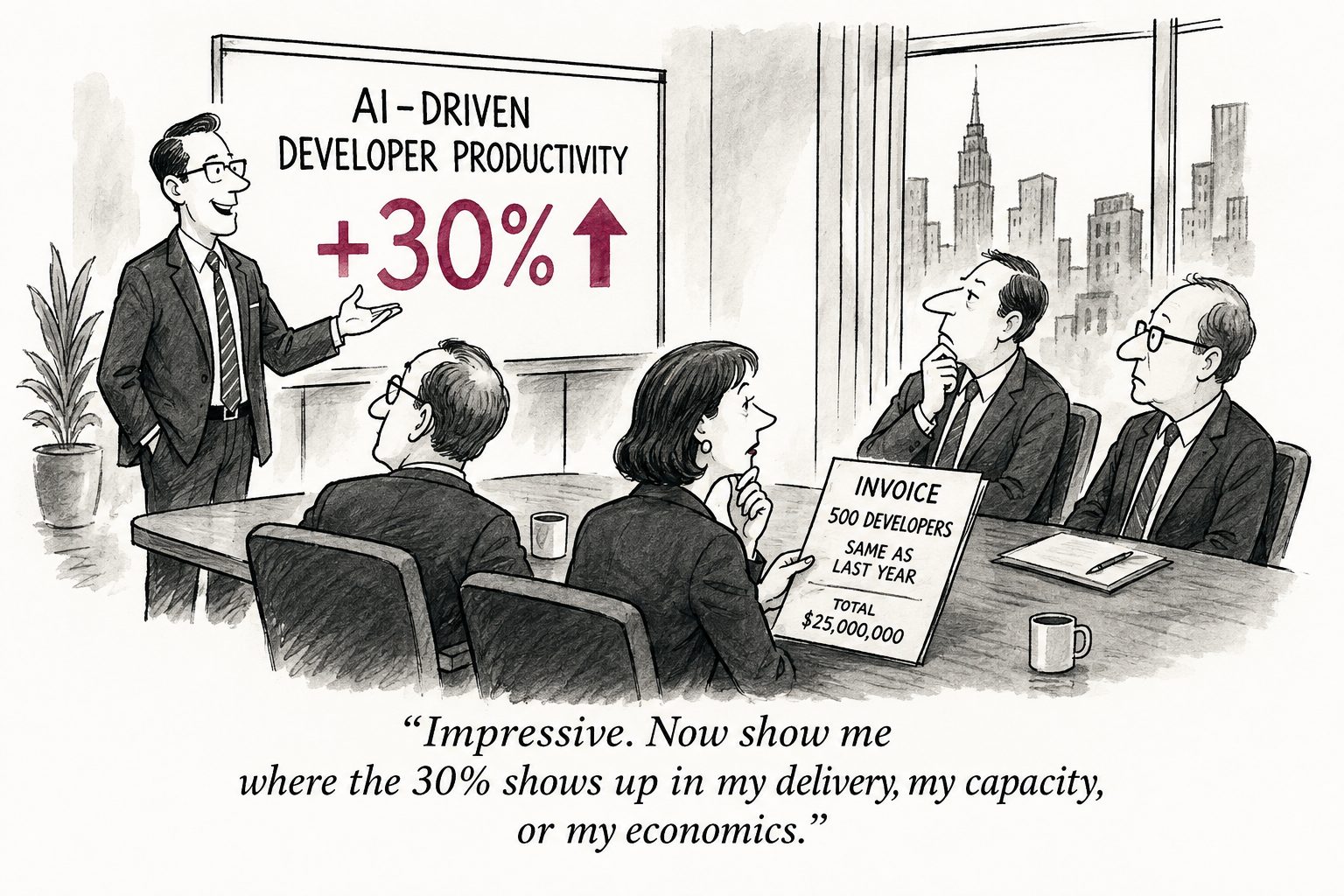
Worse still, data indicates that the “productivity” we are buying isn’t translating to bottom-line value. An analysis of 2,444 enterprise deployments conducted by Entelligence.AI reveals that 82% of enterprise developer token spend does not translate to direct, user-facing business value:
- 44% of spend goes toward debugging AI-introduced bugs.
- 27% is wasted on code rework and regeneration loops.
- 11% is eaten up by code review friction.
- Only 18% yields direct user-facing value.
Without engineering guardrails, unchecked “vibe coding” becomes a massive capital inefficiency. Corporations are paying metered rates to correct, review, and rewrite flawed AI outputs.
4. The “TokenOps” Playbook for Modern Governance
When software can spend money autonomously, financial governance must be baked into the engineering architecture itself. To prevent GitHub Copilot from driving severe budget overruns, enterprise organizations must institutionalize TokenOps—the application of FinOps principles directly to token-level software spend.
The modern VMO must collaborate with engineering leadership to execute a three-phase strategy:
Phase 1: Operational Visibility & Ingestion Controls
- Centralize Traffic: Mandate that all LLM-bound enterprise traffic and tool integrations route through a centralized AI gateway (such as Kong, Portkey, or LiteLLM) to enforce policies, manage rate limits, and track costs in real time.
- Virtual Key Tagging: Implement strict metadata instrumentation mapping every single developer query or agent session to a specific project code, business unit, and cost center.
- Enforce Circuit Breakers: Leverage native monitoring tools to execute daily cost evaluations and set hard caps on overage budgets to prevent runaway agent retry loops.
Phase 2: Technical Optimization & Accountability
- Semantic Caching & Routing: Deploy semantic caching at the gateway layer to store and serve responses for semantically similar queries, reducing redundant token generation by up to 80%. Integrate semantic routers to dynamically offload simple tasks to cheaper, lightweight models.
- Context Engineering: Train development teams to manage context windows efficiently. Instruct models to respond in concise, structured formats (like JSON) to limit expensive, verbose output.
- Chargeback Accountability: Transition token costs to direct internal chargeback models, making engineering and product managers financially accountable for their prompt architectures and consumption profiles.
Phase 3: Financial & Audit Integration
- Consumption-Based Timesheets: To maximize tax and accounting margins, integrate API gateway logs with Strategic Portfolio Management (SPM) solutions. This maps granular token transactions directly to CapEx or OpEx balance sheets. For example, token costs generated while building a new microservice during application development can be capitalized (CapEx), while token costs used to resolve legacy bugs are routed directly to maintenance (OpEx).
- Update Labor Modeling: Move away from static headcount planning. Model an employee’s total cost to the company (CTC) by factoring in role-specific token budgets alongside baseline salary and benefits. High-seniority engineers deploying advanced reasoning agents will require significantly higher technology resource allocations.
Moving From Gatekeeper to Strategic Enabler
The end of the subsidized, flat-rate AI seat has arrived. GitHub’s migration to usage-based billing means tech leaders can no longer act as passive procurement gatekeepers.
By adopting strict TokenOps disciplines, monitoring developer efficiency metrics, and restructuring corporate contracts around outcome boundaries, organizations can harness the power of generative AI engineering without exposing themselves to unbounded financial risk.