How Shadow AI Tools Enter Your Org Without a PO — and What to Do About It By Two93 | For IT & Sourcing Leaders Haunted by Unsanctioned Innovation
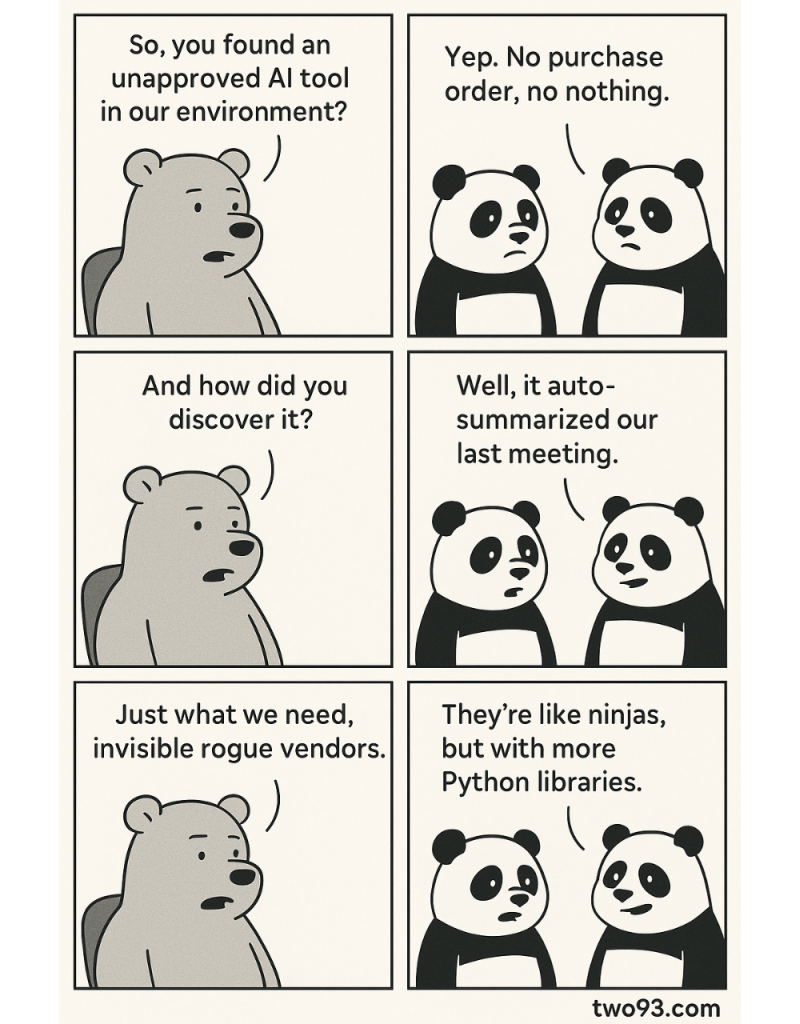
Congratulations. You just “procured” three new AI tools — except there’s no PO, no contract, and no idea where your data went.
- Your marketing team is feeding content into an LLM to punch up ad copy
- Your developers are using GitHub Copilot (unapproved) to write production code
- Your sales ops lead just fed a CSV of customer records into an “AI CRM Assistant” with a Gmail login
No legal, no procurement, no vendor governance. Just results — and risk.
Welcome to the era of invisible vendors: shadow AI tools entering your tech ecosystem through browser tabs, free trials, and unchecked enthusiasm.
💡 What Exactly Is an Invisible Vendor?
These aren’t just rogue apps — they’re functionally embedded platforms that:
- Bypass sourcing and security
- Handle sensitive data
- Drive actual business outcomes
- Have zero official paper trail
They include:
- Generative AI chatbots
- AI-powered SaaS tools with auto-enrollment
- Copilot-like developer integrations
- Chrome extensions that act like middleware for business ops
Your team loves them. Your risk and compliance team probably doesn’t even know they exist. Until they make the breach report.
🔥 Why Shadow AI Tools Are a Real Threat
- Data Exposure – If your teams are pasting customer data into an unvetted AI tool, congrats — your proprietary insights just became part of someone else’s model.
- Zero Governance – No terms of use review, no privacy clause, no exit strategy. If the tool goes down, no recourse. If it gets acquired, say goodbye to control.
- Compliance Headaches – Can you prove where your AI outputs came from? Can you defend them in court or to regulators? Didn’t think so.
- Operational Dependency – These tools creep into workflows — and suddenly your reporting pipeline depends on a freemium tool with no SLA.
🧠 How to Govern Without Killing Innovation
Because let’s be honest — the worst thing you could do is block every new tool with a 16-week procurement cycle. Instead, build a dynamic, tiered governance model that matches the speed of AI adoption.
🧭 1. Create an “AI Tool Disclosure Form”
Give business users and developers a fast, lightweight way to say, “Hey, we’re using this.” It should ask:
- What tool is being used?
- What data is being input?
- Is any customer or regulated data involved?
- Is the output being used for decisions, comms, or code?
Track this in a central log. It’s not enforcement — it’s visibility.
🔍 2. Implement a Tiered Risk Framework
Classify AI tools by risk:
- Low-risk: Used for internal brainstorming with no sensitive data
- Medium-risk: Produces business-facing outputs (slides, email copy)
- High-risk: Ingests or generates regulated/customer-critical data
Create pre-approved policies and usage rules for each.
🧱 3. Embed Guardrails Into Usage — Not Just Procurement
- Use browser plug-ins or AI security tools to monitor prompt traffic
- Add watermarking or metadata tagging to AI-generated content
- Require team leads to certify AI usage in quarterly check-ins
Think lightweight automation > manual process.
📘 4. Update Sourcing, Risk & Legal Playbooks
Start treating invisible vendors like strategic platforms:
- Add AI-related clauses to standard MSAs
- Require model provenance and data handling transparency
- Negotiate enterprise terms before tools become business-critical
Spoiler: if it’s in production, you’re already late.
✅ Helpful Next Steps
For CIOs and sourcing leaders ready to take control:
1. Launch a Discovery Campaign
Use surveys or telemetry to identify AI tools in use across teams. Offer amnesty — you want honesty, not shame.
2. Designate a “Shadow IT Squash Squad”
Cross-functional team from IT, legal, procurement, and data. Task: review top 10 unapproved tools and triage them into OK/upgrade/ban.
3. Build a Rapid AI Onboarding Program
Create a 2-week approval track for new tools. Include usage guidelines, lightweight security review, and a data impact form.
4. Embed the Framework Into NOVA (or Similar)
Ecosystem orchestration frameworks like NOVA can absorb these vendors and monitor their expansion — before they become the core tech stack behind your back.
🎯 TL;DR
- Shadow AI tools = real business impact, invisible risk
- Don’t ban innovation — guide it
- Tier your governance by risk, not by formality
- Train your sourcing teams to spot shadow AI before it goes critical
Invisible vendors are here to stay. Time to make them visible — before your board meeting makes them infamous.