
For decades, IT outsourcing has been a game of “labor arbitrage”—buying human hours in lower-cost markets. But as vendors increasingly use Generative AI to automate coding, testing, and documentation, the fundamental unit of value (the billable hour) is collapsing.
If your vendor’s developer uses GitHub Copilot to finish a 10-hour task in two hours, who keeps the remaining eight hours of profit?
To manage IT vendors effectively today, AI costing must move from a hidden internal efficiency for the vendor to a transparent line item in the contract.
1. The Death of the “Pure” Billable Hour

Traditional IT contracts are built on the assumption of linear human effort. AI breaks this linearity.
- The Incentive Problem: Under a standard Time & Materials (T&M) contract, vendors have zero financial incentive to tell you they are using AI. If they become 40% more efficient, their revenue drops by 40%.
- The “Human Rate” Trap: If you are paying $80/hour for a Senior Developer, you are paying for their expertise, but also for the time it takes to manually type and debug. If 60% of that code is generated by a bot in seconds, the “cost of production” has plummeted, but your “price of acquisition” remains static.
2. Implementing “Efficiency Gains Sharing” (EGS)

Modern IT governance requires a framework where the benefits of AI productivity are shared between the client and the provider.
- The Baseline Benchmarking: Before a project starts, establish a “Pre-AI Baseline” for common tasks (e.g., “Developing a standard REST API endpoint takes X hours”).
- The Glide Path: Acknowledge that the vendor invested in the AI tools and training. A fair EGS model might allow the vendor to keep 70% of the efficiency gains in Year 1, moving to a 50/50 split in Year 2, and eventually passing the majority of the savings to the client as the “AI-enhanced” speed becomes the new industry standard.
3. Demanding “AI-Enhanced” Productivity Metrics
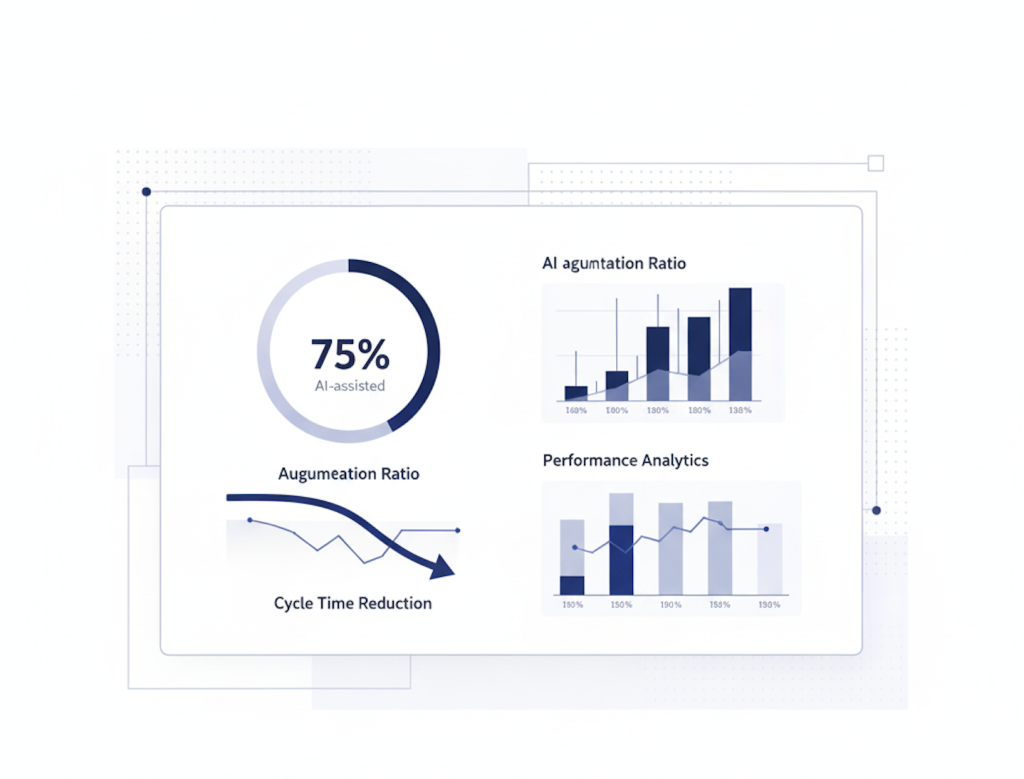
To ensure you aren’t paying human rates for machine work, your QBRs (Quarterly Business Reviews) and audits must include specific AI transparency metrics:
- Augmentation Ratio: What percentage of the delivered code was generated or significantly assisted by AI?
- Cycle Time Reduction: How has the time-to-deploy changed since the implementation of AI tools?
- The Error-to-Prompt Ratio: Are you being billed for “Human Hours” spent fixing “AI Hallucinations”? You should not pay for the time a developer spends debugging poor-quality code generated by the vendor’s own bot.
4. Shifting from “Input” to “Output” Based Costing

The ultimate solution to the AI talent anatomy shift is moving away from hours entirely.
- Unit-Based Pricing: Instead of paying for “Developer Months,” pay for “Feature Points” or “Story Points.” If the vendor uses AI to crush those points faster, they earn a higher margin, and you get your product faster.
- Outcome-Based Rewards: Tie bonuses to the performance and reliability of the software, rather than the headcount assigned to the project.
5. The Governance Question: Who Owns the “Prompt”?
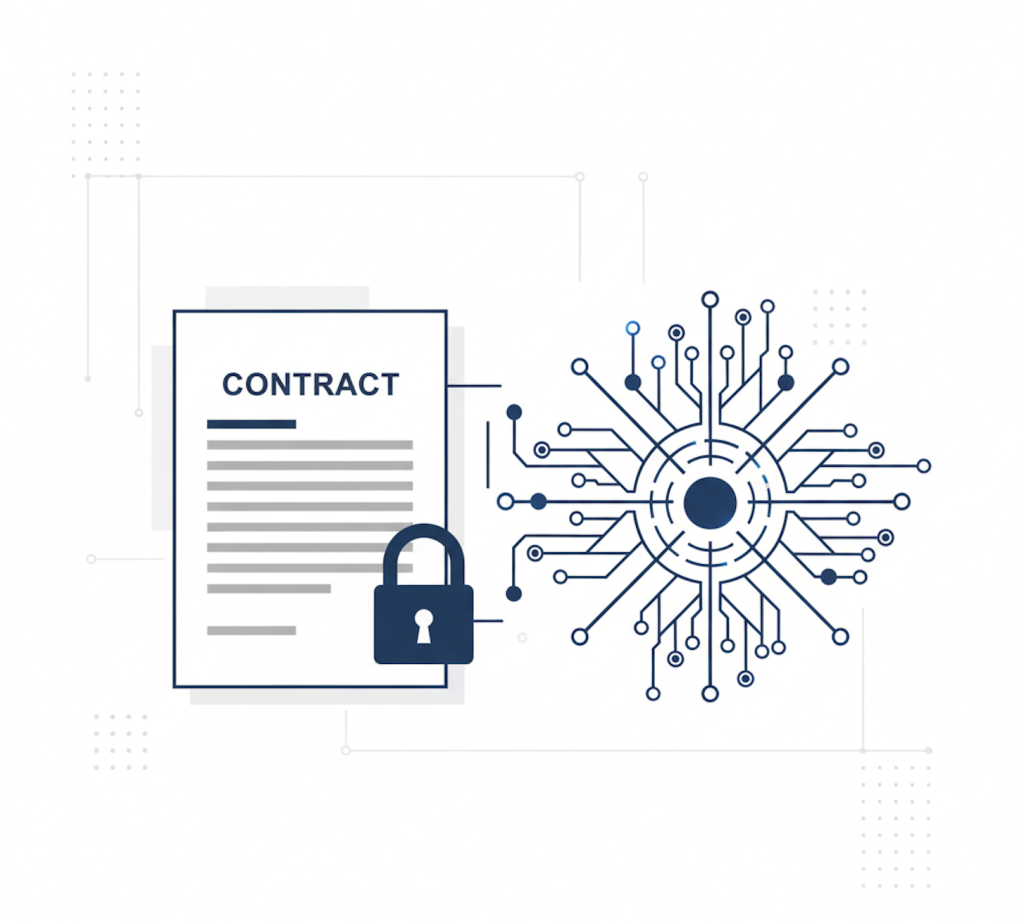
If your vendor develops a proprietary set of prompts or “fine-tuned” models specifically for your codebase to increase their efficiency, who owns that IP?
- The Risk: If you fire the vendor, and they take the “AI context” with them, your next vendor will be 50% slower and 100% more expensive because they have to start from scratch.
- The Clause: Ensure your contract defines “Prompt Libraries” and “AI Configuration Data” as part of the project’s deliverables.
The Bottom Line

The “Governance Air Gap” occurs when a vendor’s internal delivery model evolves (into AI) while the client’s billing model remains stagnant (in hours). By deconstructing the cost anatomy of AI talent, IT leaders can move from being “subsidizers” of their vendor’s AI journey to being “partners” in the resulting efficiency.