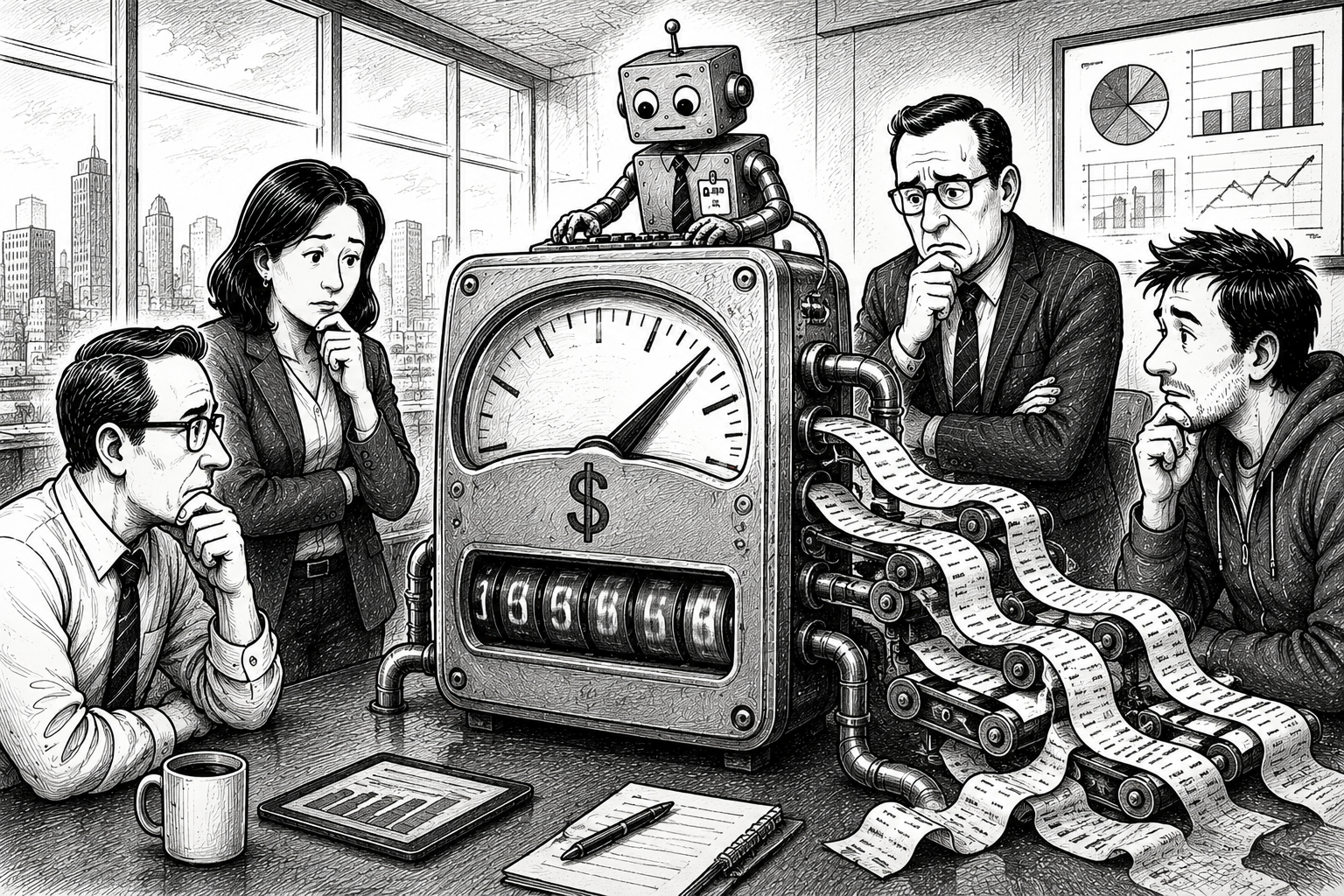
Google’s pay-as-you-go Gemini pricing promises enterprises more control. It also signals the continuation of the bigger shift: AI costs are becoming variable, behavioral and much harder to predict and these costs are shifting to the enterprises.
By Two93 Staff | August 2026
TL/DR: What IT Leaders Should Take Away
- Pay-as-you-go does not mean pay-less. It eliminates unused-seat costs but transfers more consumption risk to the enterprise.
- AI pricing is moving beyond the seat. Google, GitHub and others are increasingly combining subscriptions with tokens, credits, models and consumption.
- Agentic AI changes the cost curve. One employee action can trigger multiple model calls, tool calls, reasoning steps and retries.
- Model choice is becoming a financial decision. Routing routine work to expensive models can materially change enterprise AI economics.
- FinOps alone won’t answer the bigger question. Enterprises need AI Cost Intelligence connecting consumption to workflows, business outcomes and value.
The Runway Meter Problem
For years, buying enterprise software was reassuringly boring. Five thousand employees. A price per seat. Multiply the two numbers and take the budget to Finance.
When AI was introduced it followed that well tread path of , pay by seat.
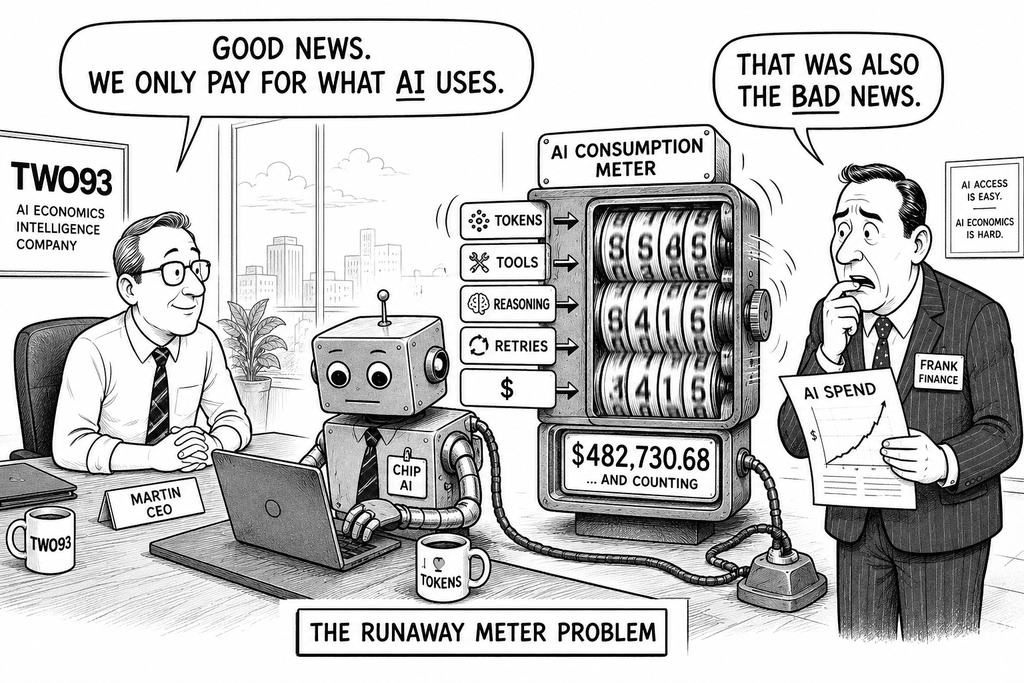
Now AI is beginning to break that model. Google recently added pay-as-you-go pricing for Gemini Enterprise, allowing companies to pay for compute and tokens consumed instead of relying entirely on traditional per-user subscriptions. It sounds like a cost-control story. It may turn out to be a cost-complexity story.
So imagine an enterprise with 5,000 potential AI users. Under the traditional model, IT buys 5,000 licenses. Six months later, perhaps 2,000 employees barely use them. That’s the old SaaS problem: shelfware.
For a number of these AI products released by Google, GitHub, OpenAI and others, the concept of selling by seat was also an early marketing technique to buy marketshare. As the cost of compute continues to rise these companies realized that per license cost alone will not cut it. Pay-as-you-go offers an obvious solution. Pay for what people actually use. Then the agents arrive. An employee asks an AI agent to review a document. The agent retrieves information, calls a model, reasons over the result, invokes another tool, sends more context back to the model and retries part of the task. The employee sees one request. The meter sees everything. And that’s where the economics change. The empty-seat problem starts disappearing. The runaway-meter problem takes its place.
GitHub Is Already Showing Us the Next Model
GitHub’s Copilot pricing changes offer another glimpse of this future. The subscription still matters, but AI Credits increasingly make consumption part of the economic equation. That changes the math.
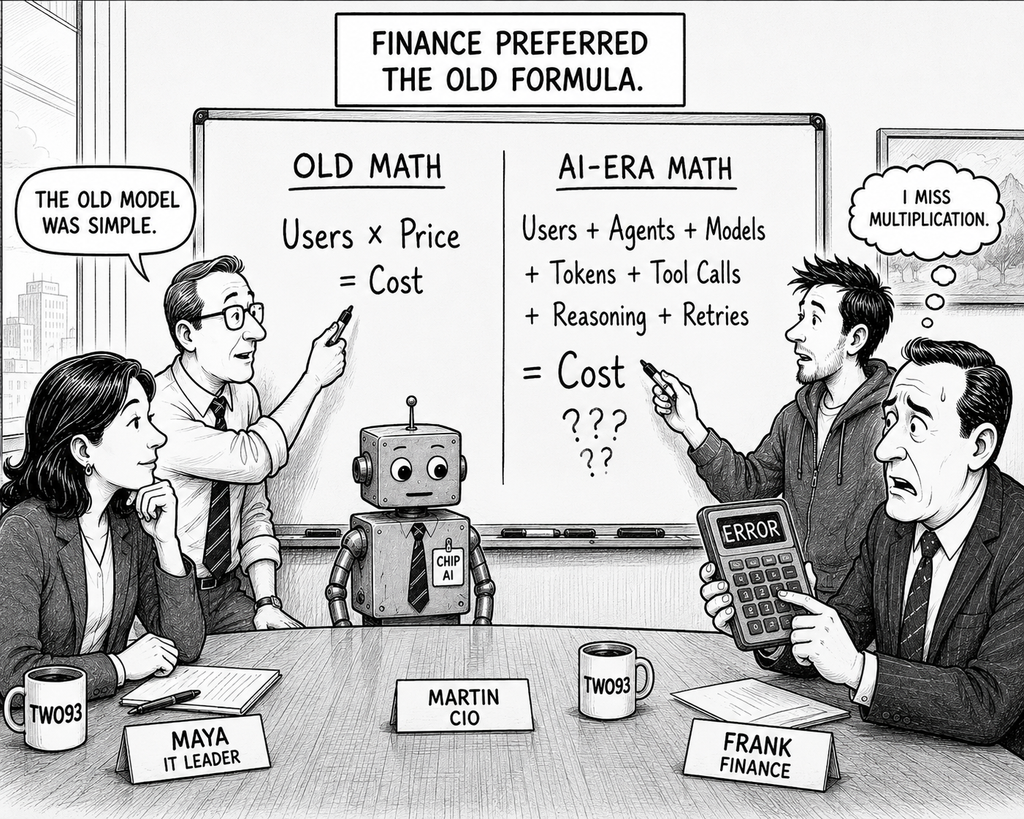
The old software calculation was roughly:
Users × Price = Cost
The emerging AI calculation looks more like:
Users + Agents + Models + Tokens + Tool Calls + Reasoning + Retries = Cost
The uncomfortable part is that several of those variables aren’t controlled directly by Procurement or Finance.
They’re influenced by user behavior and AI behavior.
A developer selecting a more powerful model can change the economics.
An agent running for 30 minutes instead of three can change the economics.
A workflow that repeatedly retries a task can change the economics.
And thousands of employees experimenting with agents simultaneously can change the economics very quickly.
The Cheapest AI Isn’t Necessarily the Lowest-Cost AI
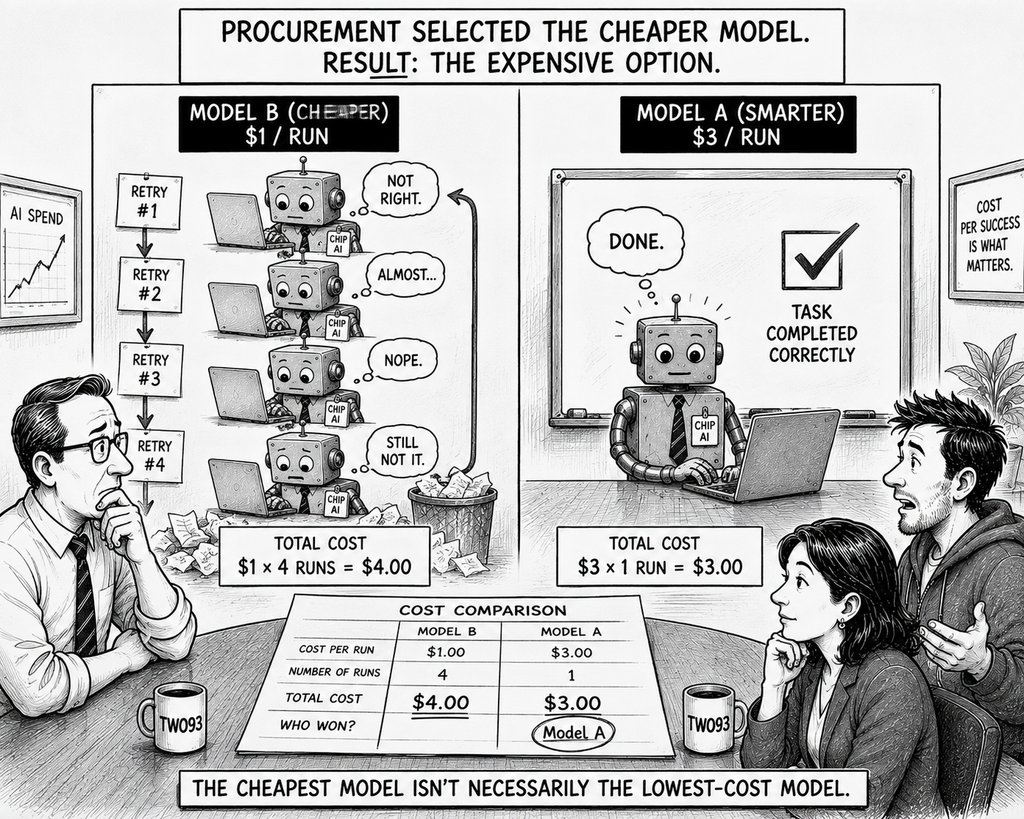
This is where enterprise AI cost management gets more interesting. Suppose Model A costs three times as much as Model B. The obvious sourcing response might be to push workloads toward Model B. But what if Model B requires four attempts to complete the task while Model A succeeds on the first? The cheaper model just became the more expensive option.
The same applies to agents. A $25 agent run might sound expensive until it replaces four hours of engineering work. A $2 agent run might sound cheap until 20,000 employees use it every day to create summaries nobody reads.
The relevant metric isn’t simply: Cost per token. It’s increasingly: Cost per successful business outcome.
This Is the Emerging AI Cost Intelligence Problem
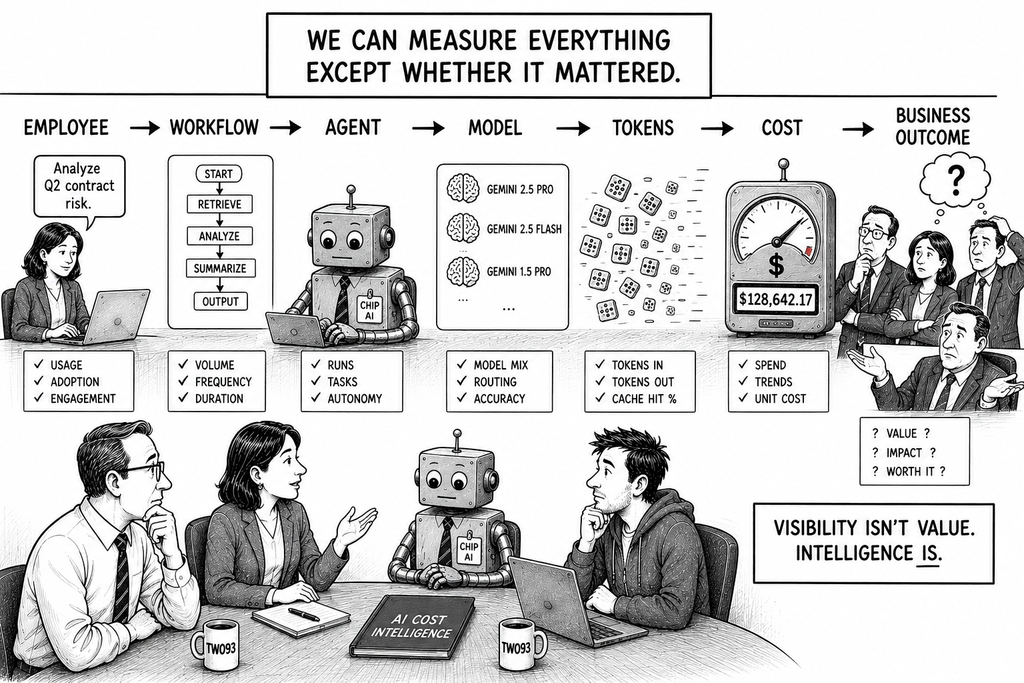
IT leaders increasingly need visibility across a chain that looks something like:
Employee → Workflow → Agent → Model → Tokens → Cost → Outcome
This chain turns a Useful Metrics into an Intelligence Metrics:
Useful Metrics:
Enterprise AI spending increased 23% this month.
Intelligence Metrics:
Enterprise AI spending increased 23%, primarily because software-development agents shifted toward higher-cost reasoning models. The change reduced engineering task-completion time by 31%, but approximately 18% of those workloads could use lower-cost models with little expected performance impact.
The Enterprise AI ROI Conversation Is Changing Rapidly
The first phase of enterprise AI was about access. Can we give employees AI? Then came adoption. Are employees actually using it? Now comes economics. What is all this AI doing, what is it costing us, and is the work worth it?
Google’s pay-as-you-go option gives enterprises more flexibility. GitHub’s evolving credit model gives developers more flexibility. Agentic platforms will give employees even more ways to put AI to work. That doesn’t necessarily mean lower costs. It means more economic choices—and more opportunities to make expensive ones. For IT leaders, the goal shouldn’t simply be reducing the AI bill. It should be understanding it. Because the companies that build AI Cost Intelligence now will be able to answer a question their competitors may struggle with later:
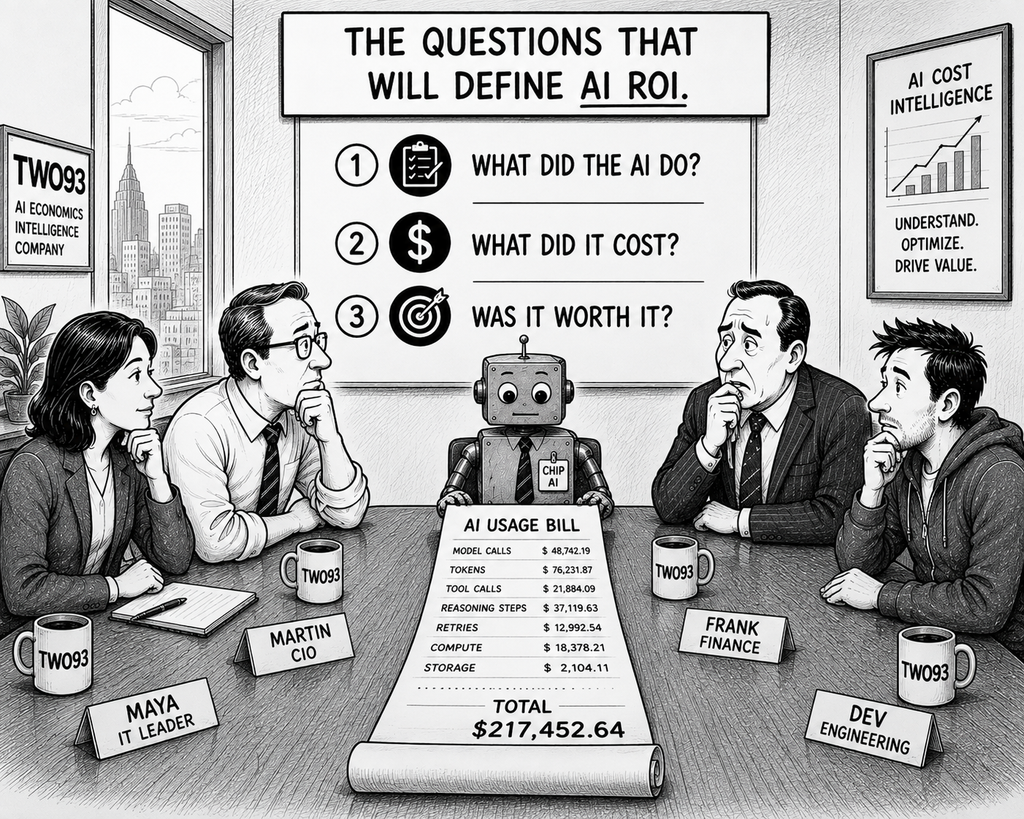
The question IT leaders should start asking:What did the AI do, what did it cost, and was it worth it?
Two93 — AI Economics Intelligence Company