By Two93 Staff
There is growing evidence that AI saves time.
Developers write code faster. Employees summarize documents in seconds. Research that once took an afternoon can sometimes be finished before the coffee gets cold.
Across a large enterprise, those minutes quickly become thousands of hours. This is good news. It also creates an awkward question.
Where did all those hours go?
Consider 5,000 employees using Copilot. Suppose each saves twenty minutes a week. That’s roughly 87,000 hours a year. Multiply those hours by a labor rate and a spreadsheet can produce several million dollars of “value” rather quickly. There is only one problem. The 5,000 employees are still there. Payroll hasn’t fallen. The outsourcing contract hasn’t necessarily changed. And the Copilot invoice has arrived right on schedule. The enterprise may have created value. It just hasn’t established what kind.
A saved hour isn’t necessarily a saved dollar.
That hour might become more work, faster delivery, better service or additional capacity. All can be valuable. But they are not the same thing as financial savings. This is where enterprise AI measurement gets interesting. We are becoming very good at counting AI. Users. Licenses. Prompts. Agents. Credits. Tokens. Premium requests. These tell us how much AI is being used. They don’t necessarily tell us what the enterprise received in return. And AI may soon give us the opposite of the old SaaS shelfware problem.
Instead of buying software nobody uses, enterprises could have AI that everybody uses—and whose cost keeps rising precisely because they use it.
The dashboard is green.So is the invoice. That doesn’t make AI a poor investment. It simply means adoption cannot be the final measure of success. The better approach is to follow the work.
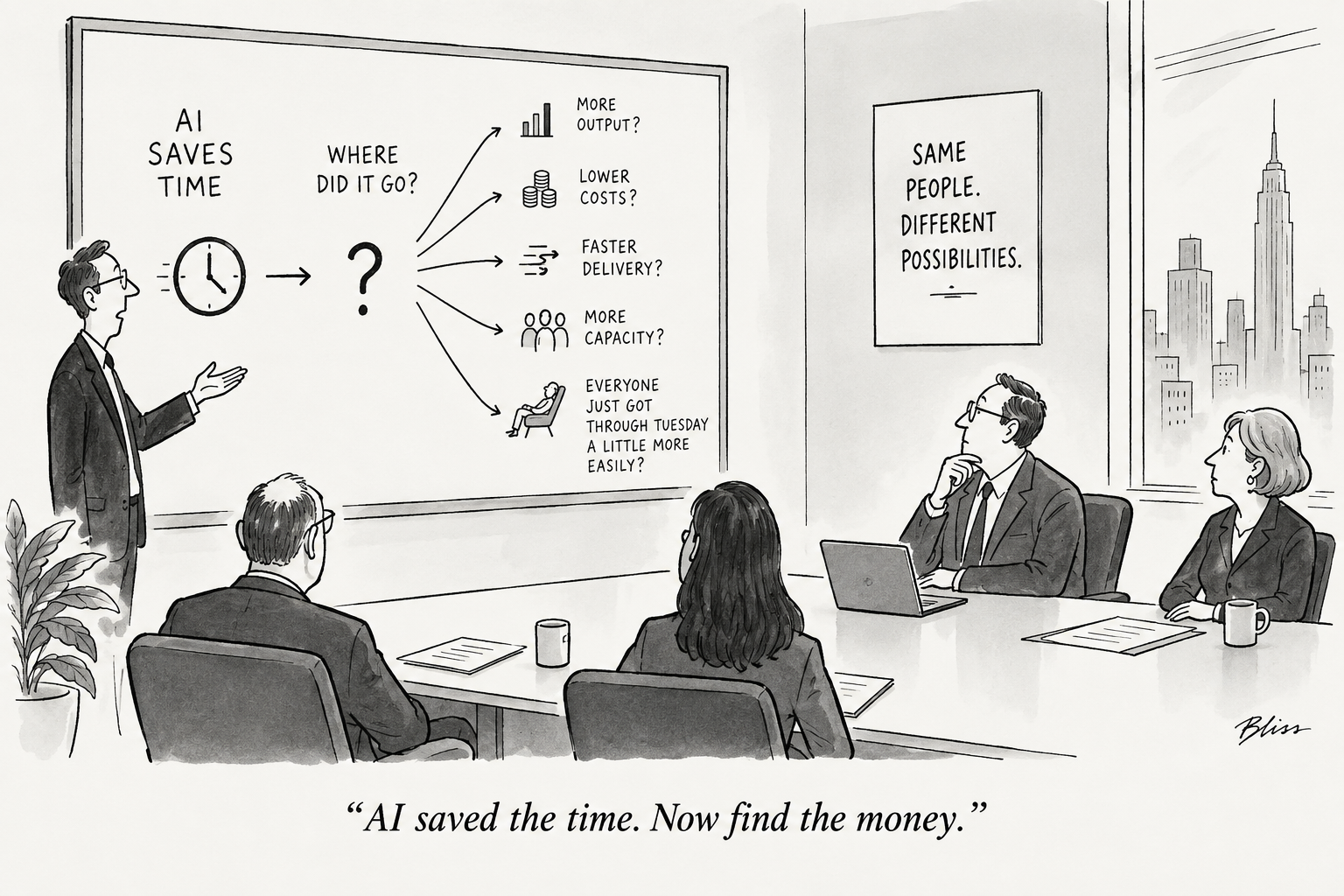
If AI makes a team 20% more productive, what happened to that 20%?
- Did output increase?
- Did costs fall?
- Did projects finish sooner?
- Did the organization need fewer external resources?
- Or did everyone simply get through Tuesday a little more easily?
- Those are very different economic outcomes.
The $293 Question
When the next AI business case says 100,000 hours were saved, don’t argue about the hours.
Ask:
Where did they go?
If they produced more, measure the output.
If they reduced cost, show the reduction.
If they created capacity, call it capacity.
But don’t turn every saved hour into a dollar simply because Excel permits it.
AI may indeed deliver enormous productivity. The enterprise challenge is making sure that somewhere between the AI dashboard and the P&L, the value doesn’t disappear.
Two93 | AI Economic Intelligence for the Modern Enterprise™