Two93 Market Update | November 2026
TL;DR
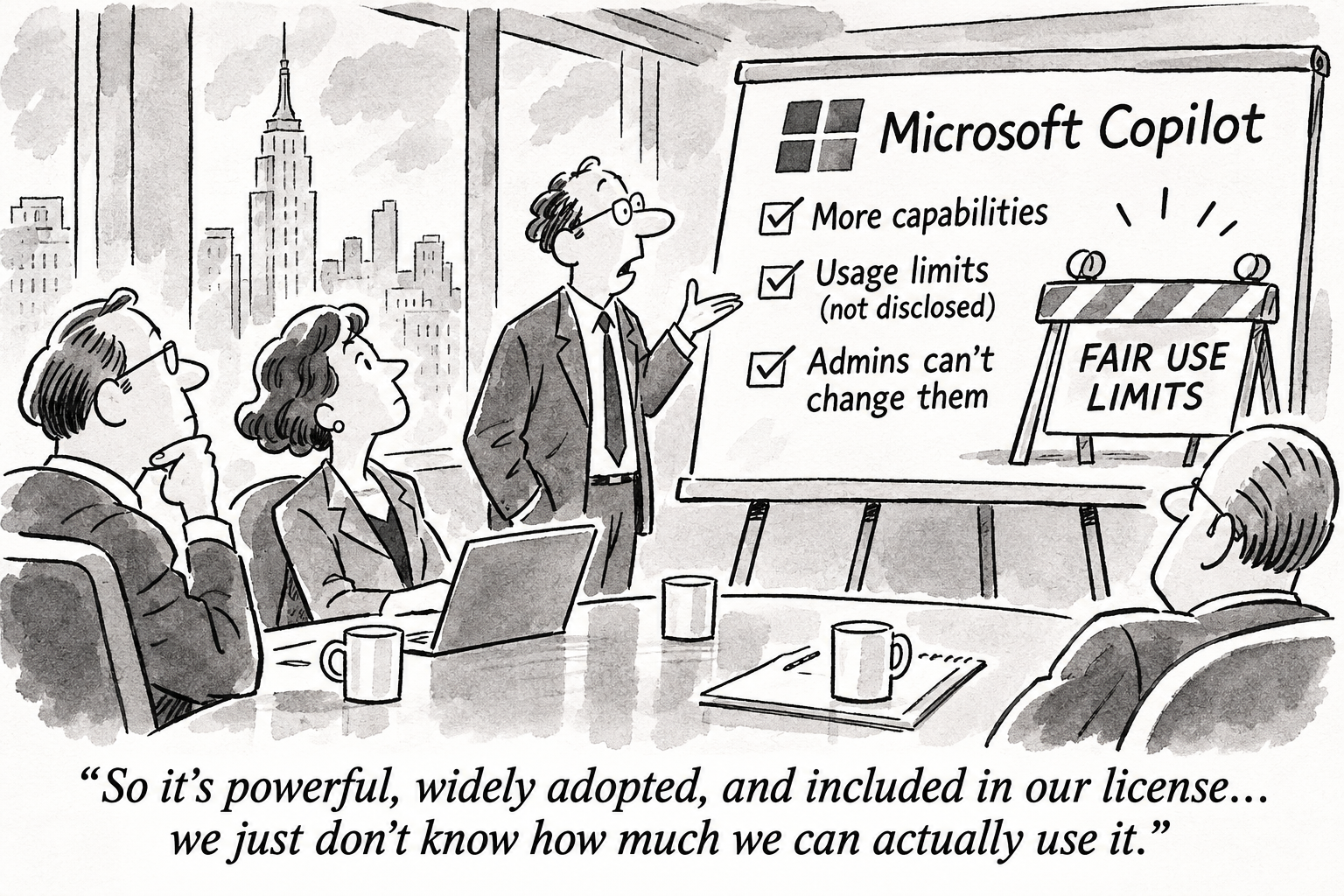
Microsoft is expanding undisclosed fair-use restrictions on Copilot Chat for enterprise users without the separate paid Microsoft 365 Copilot license.
The issue isn’t that limits exist. AI computing costs money. The issue is that enterprises cannot see or configure those thresholds.
For CIOs and CFOs, this creates a fundamental question: How do you decide who needs a paid AI license when you cannot reliably measure the limits of the included service?
The Real Cost of Included AI
Many organizations have introduced employees to Copilot Chat through their existing Microsoft 365 subscriptions, without purchasing additional Copilot licenses for everyone.
It’s a sensible adoption strategy.
But Microsoft is now expanding fair-use restrictions to additional Copilot Chat capabilities. The rollout began November 2 for organizations with 2,000 or fewer seats, with larger organizations scheduled for November 9.
Microsoft isn’t publishing the numerical thresholds, and administrators cannot configure or override them.
Imagine an employee using Copilot Chat to prepare a monthly business review. If they encounter a restriction on a needed feature, they may have to wait or complete the work another way.
That’s an illustrative scenario, but it highlights the problem: an included AI capability isn’t necessarily a predictable operational service.
The Licensing Economics
Consider an enterprise with 10,000 employees.
- 1,000 have paid Copilot licenses.
- 9,000 rely on included Copilot Chat.
- Upgrading another 500 users at an illustrative $30 per user per month adds $180,000 annually.
- Upgrading 2,000 adds $720,000 annually.
Those investments might be justified. But how do you know?
Adoption dashboards show who’s using AI. They don’t necessarily show which employees are encountering restrictions, which workflows are affected, or whether upgrading will generate sufficient value.
Without that evidence, enterprises risk making licensing decisions based on complaints and assumptions rather than economics.
Three Actions for IT Leaders
1. Segment by workload, not adoption. Occasional users and employees who depend on AI throughout the day have different requirements.
2. Measure operational impact. Capture restrictions, affected workflows, delays, and user feedback. Don’t assume Microsoft provides all the telemetry you need.
3. Make licensing an economic decision. Compare incremental licensing costs with measurable productivity, reliability, and business outcomes. Ask Microsoft for greater visibility into service limits.
The Two93 Takeaway
Microsoft has legitimate reasons to manage AI consumption. Enterprises have equally legitimate reasons to expect transparency.
As AI pricing evolves through subscriptions, credits, tokens, and priority access, IT leaders need to understand not just what a service costs, but how dependably it delivers value.
Adoption tells you who's using AI. Economics tells you whether it's worth paying for.Source: Computerworld — Microsoft extends undisclosed usage restrictions on Copilot Chat