Podcast Version , press play to listen
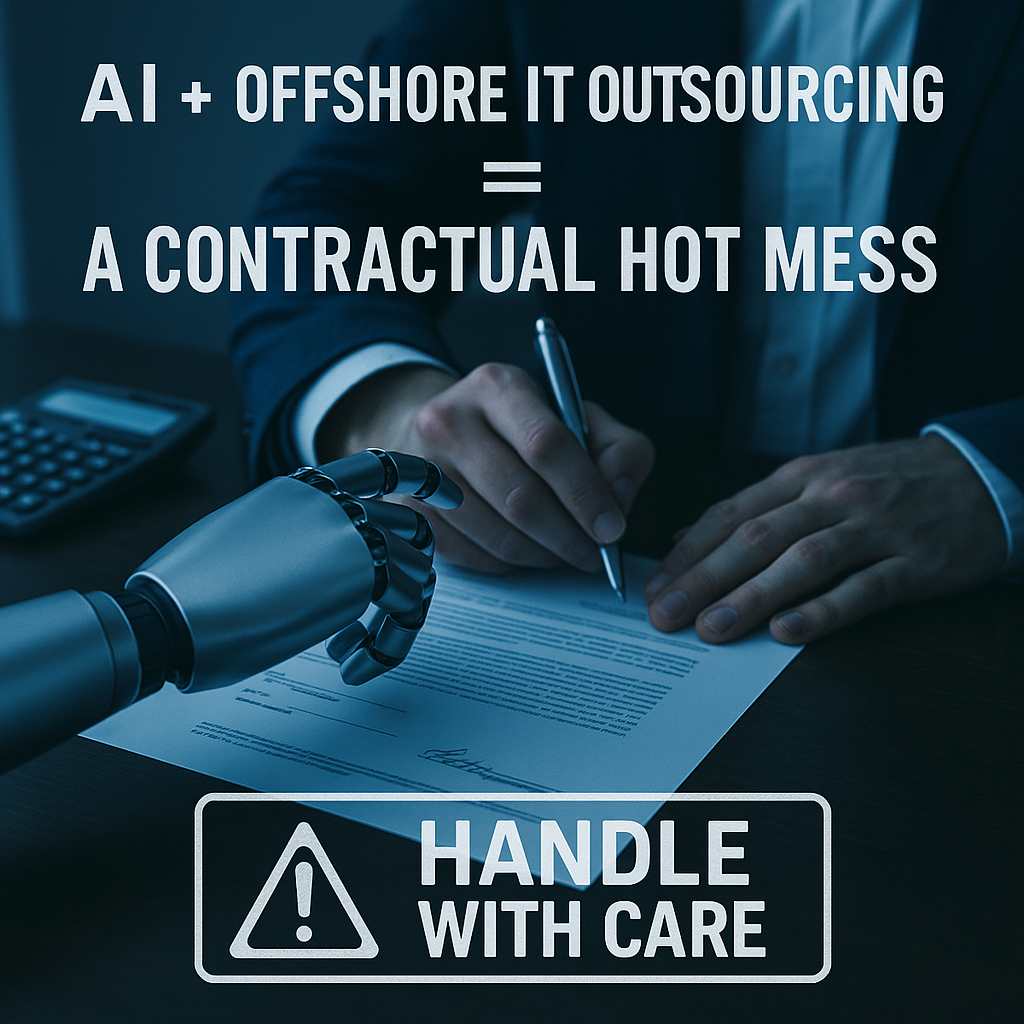
Welcome to the brave new world where artificial intelligence meets offshore IT outsourcing—and your contracts just got a whole lot messier. If you’re thinking, “Great, another thing legal needs to worry about,” you’re not wrong. But don’t worry, we’re here to walk you through the jungle of legal jargon, data drama, and IP landmines—with a bit of humor and only minor existential dread. 🫠
1. Data Management: It’s Not Just “Copy Paste” Anymore
AI eats data like it’s at an all-you-can-analyze buffet. So naturally, your contract better spell out exactly how your vendor handles your data.
- Are they using it to “enhance their models”? 🚩
- Is it living in a clean, segregated data environment? 🚿
- Are they really GDPR/CCPA compliant or just saying so in a PowerPoint? 🧐
Be specific. Be paranoid. Be protected.
2. Liability: When the Bot Breaks Something, Who Pays?
You don’t want to find out the hard way that your vendor isn’t liable when their AI misclassifies your customers or starts hallucinating financial advice. 😵💫
Define who’s on the hook when:
- The AI spits out biased or incorrect outputs 🧠💥
- Someone sues because their rights got trampled 👩⚖️
- Your CEO ends up apologizing on LinkedIn again 🙃
Pro tip: “We’ll figure it out later” is not a strategy.
3. IP Ownership: Who Really Owns the Robot’s Brain?
Let’s get one thing straight: if you’re paying for it, you should probably own it. But AI makes this messy.
Your contract should clarify:
- Who owns the models? (Hint: it should be you 🫵)
- What happens to the training data?
- Can they license your outputs to someone else? (Ew, no.)
And don’t forget to guard against third-party IP landmines—they’re everywhere and they’re lawsuit-shaped.
4. Regulatory Risk: Just EU AI Act Things 🇪🇺
The EU AI Act is here and it’s not messing around. If you’re doing business with or in the EU, your contract better respect the new sheriff in town.
Make sure:
- The type of AI being used is well-documented.
- There’s a compliance clause that won’t age like milk 🥴
- You’re not locked into a vendor that ghosts you when the rules change
Also: Keep an eye on emerging rules elsewhere. The U.S. is trying, but you know how we are with regulations. 🙃
5. Ethics & Bias: Robots Have Issues Too
No one wants to be in the headlines for deploying a biased AI that ruins lives. Build those ethical guardrails into your contracts:
- Require transparency in decision-making.
- Include clauses on bias mitigation and explainability.
- Acknowledge potential job displacement and work toward fairness—don’t be that company.
Remember: AI ethics isn’t just for TED Talks. It’s for clause 34.3(b).
6. Must-Have Contractual Clauses: The Legal Avengers Assemble 🧾⚔️
Here’s your shopping list for a contract that won’t collapse at the first glitch:
✅ Definitions for AI terms (no, “magic black box” doesn’t count)
✅ Scope of work with clear AI deliverables and limitations
✅ Data use restrictions (vendors: hands off my data)
✅ IP ownership spelled out in neon
✅ Liability & indemnity clauses sharper than a legal katana
✅ AI performance SLAs (accuracy, uptime, not being weird)
✅ Security & privacy compliance (GDPR, CCPA, common sense)
✅ Audit rights—trust, but verify
✅ Termination clauses for AI failures or “oops we broke the law” moments
✅ Exit strategy with AI/data handoff that doesn’t feel like a breakup
✅ Ethics clauses that show you actually care
TL;DR: AI Outsourcing Contracts Are Not for the Faint of Heart
AI-enabled offshore outsourcing isn’t just a trend—it’s the new normal. But the legal side? It’s still catching up. So write your contracts like your company’s reputation depends on it (because it kinda does).
And remember: Just because your vendor says “Don’t worry, we’ve got AI under control,” doesn’t mean you shouldn’t read every line of that contract like your bonus depends on it. Because it might. 💸