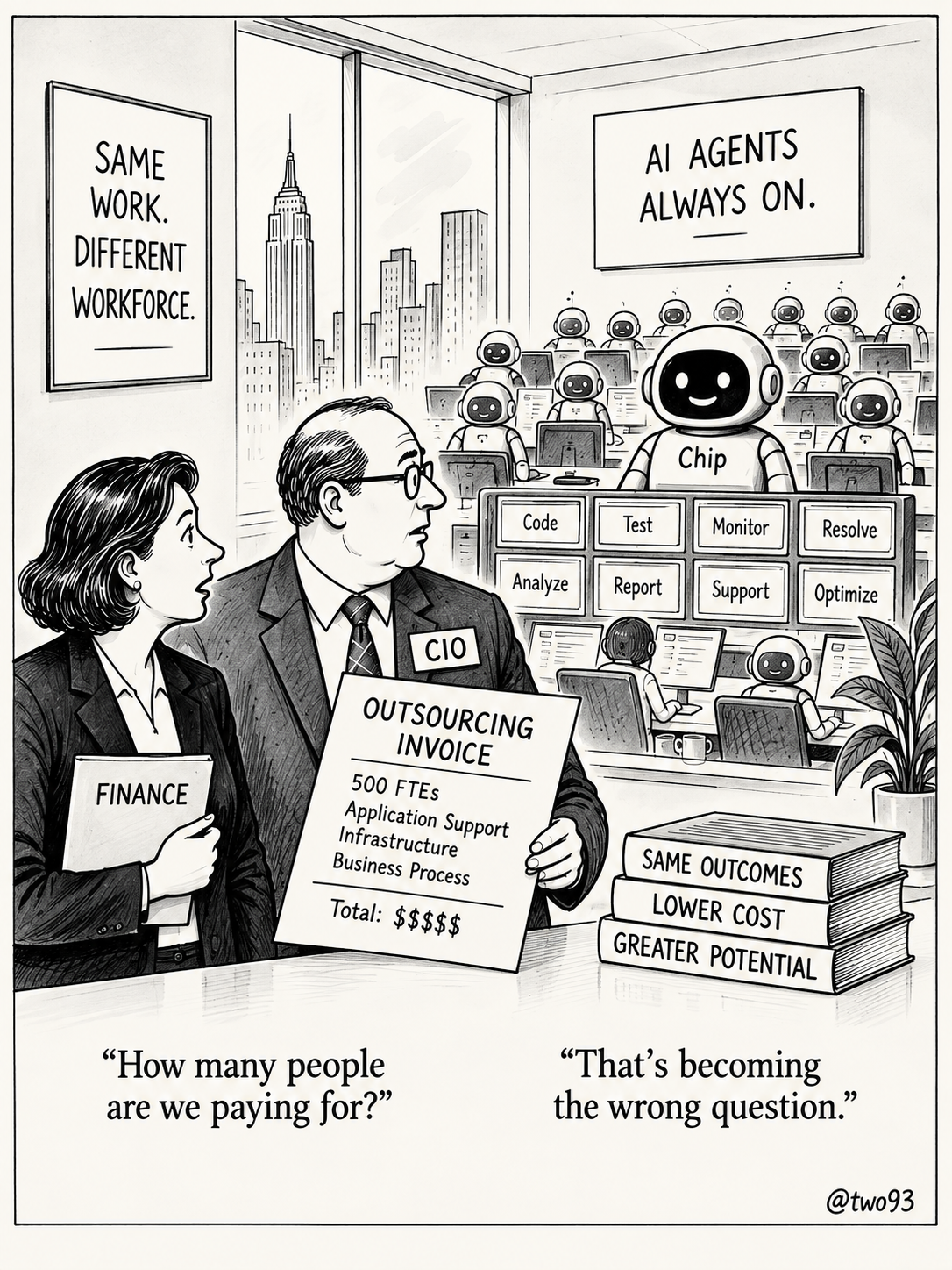
As AI begins doing work once performed by people, CIOs need a new economic model.
By Two93 Staff | September 2026
The economics of outsourced IT work were relatively understandable for the past decade or more.
People × Time × Rate.
A provider supplied 500 developers. The enterprise knew the rate card, location mix and annual cost. More capacity generally meant more people—or better productivity from the people already there.
AI changes that equation. A developer can now use AI to generate code, write tests, review pull requests or investigate defects. Increasingly, agents can perform portions of that work themselves. The enterprise is no longer paying only for human capacity. It is beginning to pay for machine capacity as well. And that raises a new question for CIOs:
What does AI work actually cost?
Two Cost Models Are Colliding
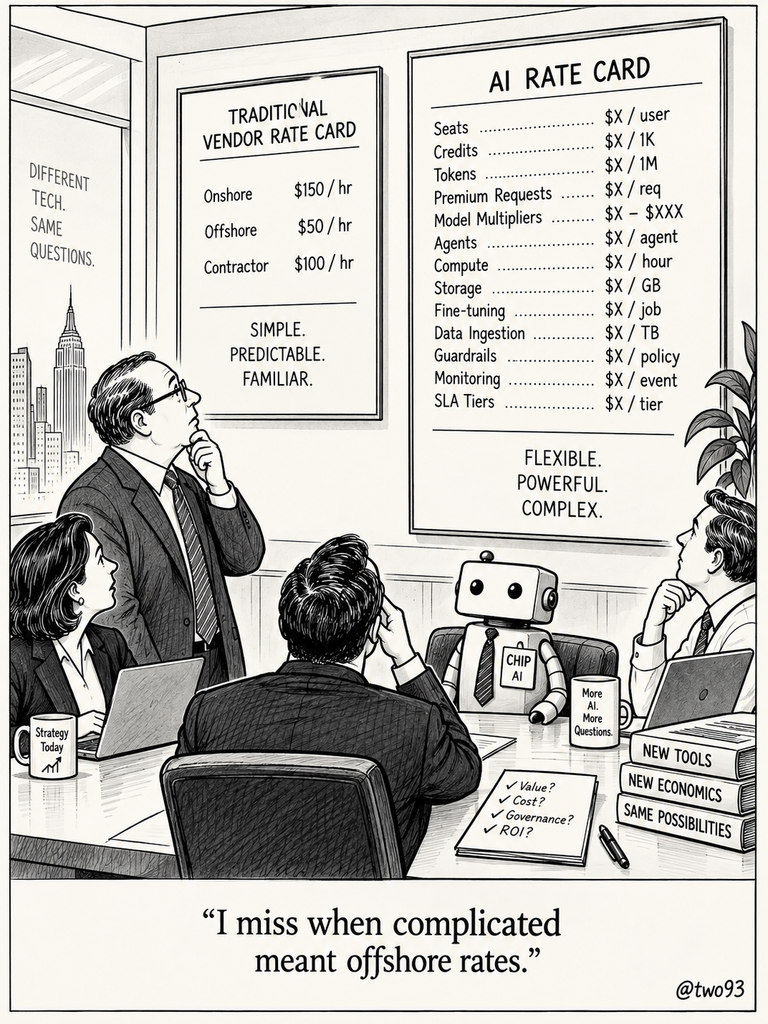
Traditional IT outsourcing measures:
FTEs → Hours → Rates → Labor CostAI introduces another chain:
Seats → Credits → Tokens → Models → Agents → Compute → AI CostMost enterprises track these separately. They shouldn’t. Imagine AI allows a 500-person outsourced engineering team to produce 20% more work. That’s valuable—but only if the enterprise captures the benefit. If the customer continues paying for 500 people and starts paying for the AI that makes those people more productive, costs may actually rise. The provider becomes more productive. The enterprise gets a bigger AI bill. That is not necessarily economic value.
Move From Cost per Person to Cost per Outcome
This is why AI cost per user is only a starting point.
CIOs should progressively move toward:
AI Cost per Active User
→ AI Cost per AI-Assisted Task
→ AI Cost per PR
→ AI Cost per Successful Production Change
And ultimately:
Total Cost per Successful Outcome
Now the economics become visible.
If a successful production change previously cost $2,400 in labor and now costs $1,900 in labor plus $120 of AI, AI has improved the economics.
But if the enterprise still pays $2,400 for labor plus $120 for AI, productivity may have improved while enterprise economics got worse.
A Practical Starting Point
Don’t start with enterprise-wide AI ROI.
Pick one outsourced team, one AI platform and one measurable workflow.
Track five things:
| Measure | Example |
|---|---|
| Labor Cost | FTEs × rate |
| AI Cost | Licenses + consumption |
| AI Consumption | Credits, tokens, agent activity |
| Output | PRs, releases, tickets |
| Quality | Successful changes, defects, rework |
Then track Total Cost per Successful Outcome for several months.
The objective is simple:
Is AI reducing the total cost of getting useful technology work done?
And then ask the harder question:
Who is capturing the productivity dividend?
The Next Sourcing Conversation
This is where AI economics and IT sourcing begin to converge.
FTE and rate-card contracts won’t disappear overnight. But as AI performs more of the work, CIOs will need contracts that increasingly recognize productivity, unit costs, outcomes and AI consumption.
Because the enterprise can no longer look only at the cost of people—or only at the cost of AI.
It needs to understand the economics of the work itself.
The question isn’t whether AI makes IT teams more productive.
It’s whether AI lowers the cost of delivering successful outcomes—and whether the enterprise captures the benefit.
Two93 | AI Vendor Economic Intelligence for the Modern Enterprise™