
How Ungoverned Pilots Lead to Data Nightmares, Shadow IT, and Third-Party Chaos
By Two93 | For CIOs Who’ve Seen Things
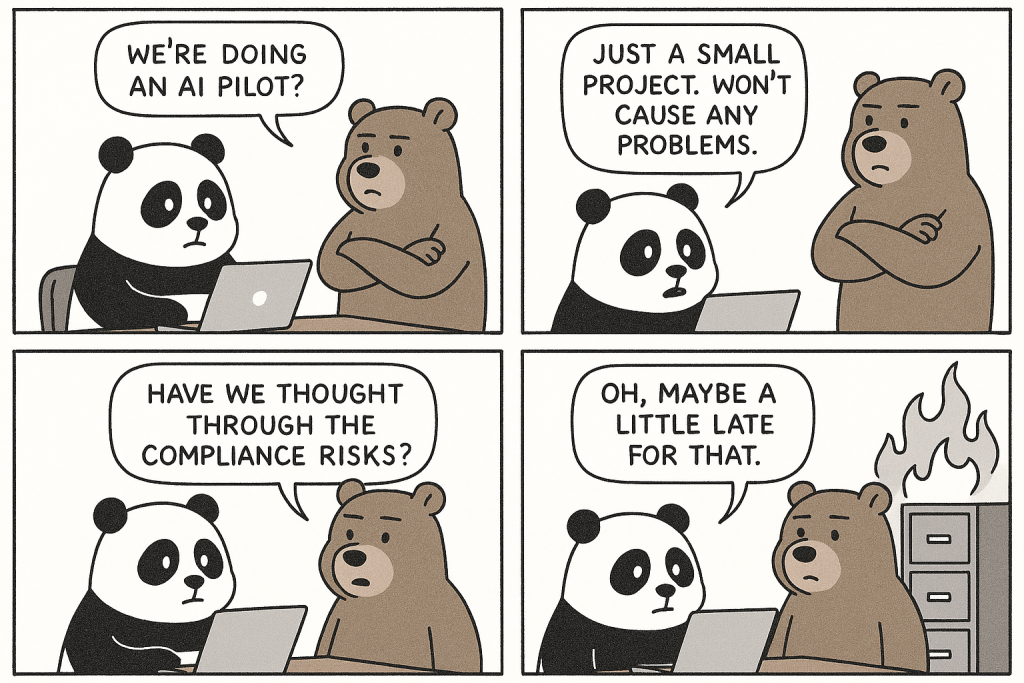
So, you approved that “small AI pilot” six months ago.
No big deal, right?
A few folks from data science, a cloud GPU bill, maybe a lightly worded DPIA… how bad could it get?
Well, fast forward:
- 3 new third-party APIs
- 1 missing data-sharing agreement
- An AI model trained on confidential client data
- And a compliance lead who now refers to you only in sighs
Welcome to the brave new world of ungoverned AI pilots, where speed meets silence — and the cleanup cost gets politely kicked to your budget.
🧠 The “Let’s Just Try This” Era of AI
This is how it starts:
“We just want to see if it works.”
“It’s internal for now — no sensitive data involved.”
“Legal will bless it later, promise.”
And suddenly you’re:
- Using a third-party LLM API hosted in an entirely different region
- Feeding it structured and unstructured data that’s definitely subject to regulatory controls
- Copy-pasting outputs into production-like systems
- And retroactively writing documentation for an AI pipeline that nobody remembers architecting
The result?
A growing list of AI experiments that live outside your org’s risk model, integration plan, or sometimes even basic authentication policy.
📦 Shadow IT… Now with a Neural Network
We’ve been fighting Shadow IT for years: rogue SaaS apps, unsanctioned file-sharing tools, marketing teams using “free CRMs” that cost you an audit.
But AI shadow tech is a different beast:
- It’s embedded, not standalone
- It touches sensitive data, often invisibly
- And it’s often connected to external models, with unclear data retention, IP, or training boundaries
In short: you don’t see it until the breach notice gets drafted.
🤯 When AI Meets Third-Party Sprawl
Let’s talk about the third-party side of this mess.
That “cool startup” your analytics team looped in?
- Doesn’t have a SOC 2
- Uses subcontractors in three countries
- And just added your client’s data to their model training set because… “it improves accuracy”
And while your procurement policy technically prohibits this, the integration happened via a low-code workflow tool no one told you about. It’s now mission-adjacent.
💸 And Then There’s Compliance…
You know the line item on your compliance budget labeled “AI Controls”?
Yeah. It didn’t exist last year.
Now you’re buying tools for:
- AI model explainability
- Prompt injection testing
- Data lineage tracing for AI pipelines
- Vendor model transparency reporting
You’re not just governing data anymore — you’re governing models that interpret, transform, and sometimes invent it.
🔍 What CIOs Should Be Asking
So, how do you get out in front of this?
You can’t block AI — nor should you.
But you can orchestrate it.
Here’s what modern CIOs are starting to ask:
- What’s our governance layer for internal AI projects?
- Which third-party models are touching our data — and how are we tracking that?
- What’s our exit strategy if a vendor-trained model gets embedded into workflows?
- Who owns the outputs — and who’s liable if they go sideways?
Most importantly: how do we scale AI without turning our compliance program into a fire suppression team?
So What Can I Do ?
This is exactly why some orgs are shifting toward vendor and platform orchestration models — ones that align AI initiatives with architecture, data policy, and third-party contracts from the start.
No buzzwords. Just clarity.
(We call ours NOVA™, but we’re not here to make this a sales pitch. Yet.)
🧠 TL;DR for the Board Deck
- AI innovation is accelerating — but so is risk.
- Ungoverned pilots = hidden liabilities.
- Shadow AI tools + unvetted vendors = breach bait.
- CIOs must move from “permission gatekeeper” to “ecosystem orchestrator.”
- Compliance isn’t the problem. Blind spots are.
Want to talk about mapping your AI vendor sprawl before the auditors do it for you?