
By Two93 | Because “We’ll Just Ask ChatGPT” is Not a Roadmap
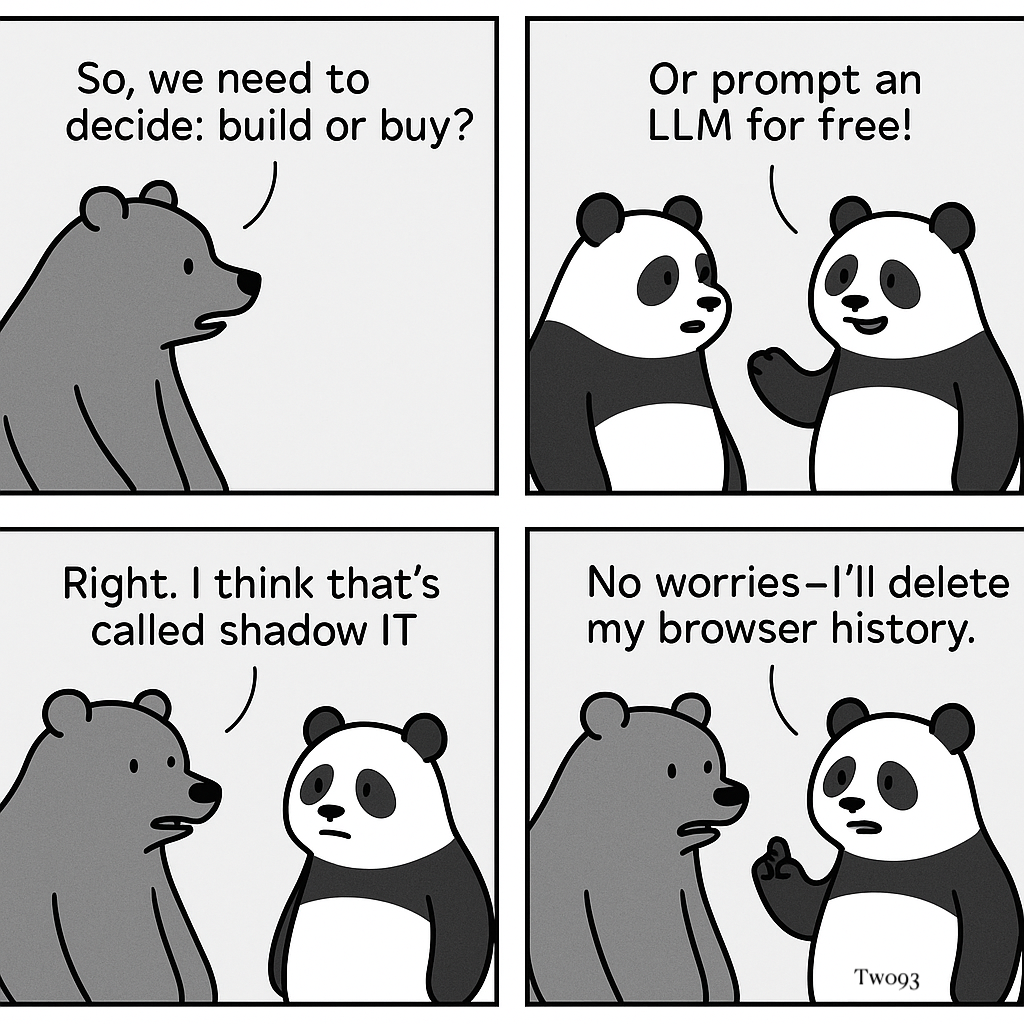
Remember when vendor strategy was just a choice between building software in-house or buying it from someone already selling the same thing to five of your competitors?
Well, welcome to the Generative AI era, where there’s now a third option:
“Let’s just prompt ChatGPT to do it.”
No contracts. No integrations. Just a cleverly worded question and a surprisingly detailed answer.
So now, CIOs and sourcing professionals aren’t just debating Build vs. Buy — they’re navigating Build, Buy, or Prompt.
And let’s be clear: each comes with very different risks, rewards, and long-term regrets.
1️⃣ Buy – The Traditionalist’s Choice (Now with More AI Stickers)
Still the default for most enterprises:
- Pick a platform
- Sign a 3-year deal
- Onboard the vendor
- Get 70% of the features you actually need
Now with bonus GenAI features like:
- “Smart” email summarizers that need constant retraining
- Chatbots that hallucinate legal advice
- Prompt boxes duct-taped onto legacy workflows
Pros:
✅ Proven vendor
✅ SLAs (in theory)
✅ Someone else owns the roadmap
Cons:
❌ Cost
❌ Customization limits
❌ “AI” often just means slightly better autocomplete
2️⃣ Build – For When You Have Engineers (and Budget… and Patience)
The DIY route:
- Pick an AI model (OpenAI, Anthropic, Mistral, etc.)
- Wire it into your platform
- Train it on your data
- Hope legal doesn’t find out about the IP clause in the API doc
Pros:
✅ Full control
✅ Tailored to your domain
✅ Strategic differentiation
Cons:
❌ Infrastructure overhead
❌ Security and compliance landmines
❌ Your data scientists are now prompt engineers with trust issues
3️⃣ Prompt – The Wildcard Nobody Planned For
Let’s be real: this is already happening.
- Developers asking ChatGPT for architecture patterns
- Analysts pasting data into LLMs to “find insights”
- Procurement teams generating policy templates in seconds
- And marketing quietly building entire microsites before IT even hears about it
Pros:
✅ Fast
✅ Cheap
✅ Shockingly good… sometimes
Cons:
❌ Zero governance
❌ No audit trail
❌ Training vendors with your IP… for free
In short: it works — until it really doesn’t.
🎯 What This Means for Sourcing and Vendor Strategy
You’re not just selecting platforms anymore.
You’re selecting modalities:
- Platforms you buy
- Capabilities you build
- Knowledge flows you prompt
And the lines are getting blurrier every quarter.
Vendors are embedding LLMs into their tools.
Employees are going rogue with open models.
And the AI governance policy? Still in “draft-v7-final-FINAL.pdf”.
So your job now includes:
- Evaluating AI API partners like you would a core system vendor
- Classifying prompt-based workflows as actual IT assets
- Auditing where generative outputs are entering your business processes
- Deciding what must be governed, and what can be left to “controlled chaos”
🧩 Strategic Ecosystem Design — Not Just RFPs
This isn’t about which vendor has the best AI-powered dashboard.
It’s about deciding where you standardize, where you experiment, and where you trust human judgment over a chatbot.
Sourcing professionals must evolve from gatekeepers to orchestrators:
- Curating build vs. buy vs. prompt strategies by use case
- Embedding AI-risk criteria into vendor onboarding
- Supporting internal AI experimentation without opening a compliance black hole
The smart ones are adopting structured frameworks to do this.
🧠 TL;DR
The vendor decision tree has changed:
- Buy when you need scale, support, and SLAs
- Build when you want control and competitive edge
- Prompt when speed wins — but only if you can govern the output
In the AI era, every decision is a trade-off between speed, control, and risk.
So choose wisely — and maybe ask ChatGPT after you’ve read the contract.
Want help mapping your Build-Buy-Prompt ecosystem before it maps you?