AI is beginning to change the economics of technology services. The productivity gains are real. Who benefits from them is a different question.
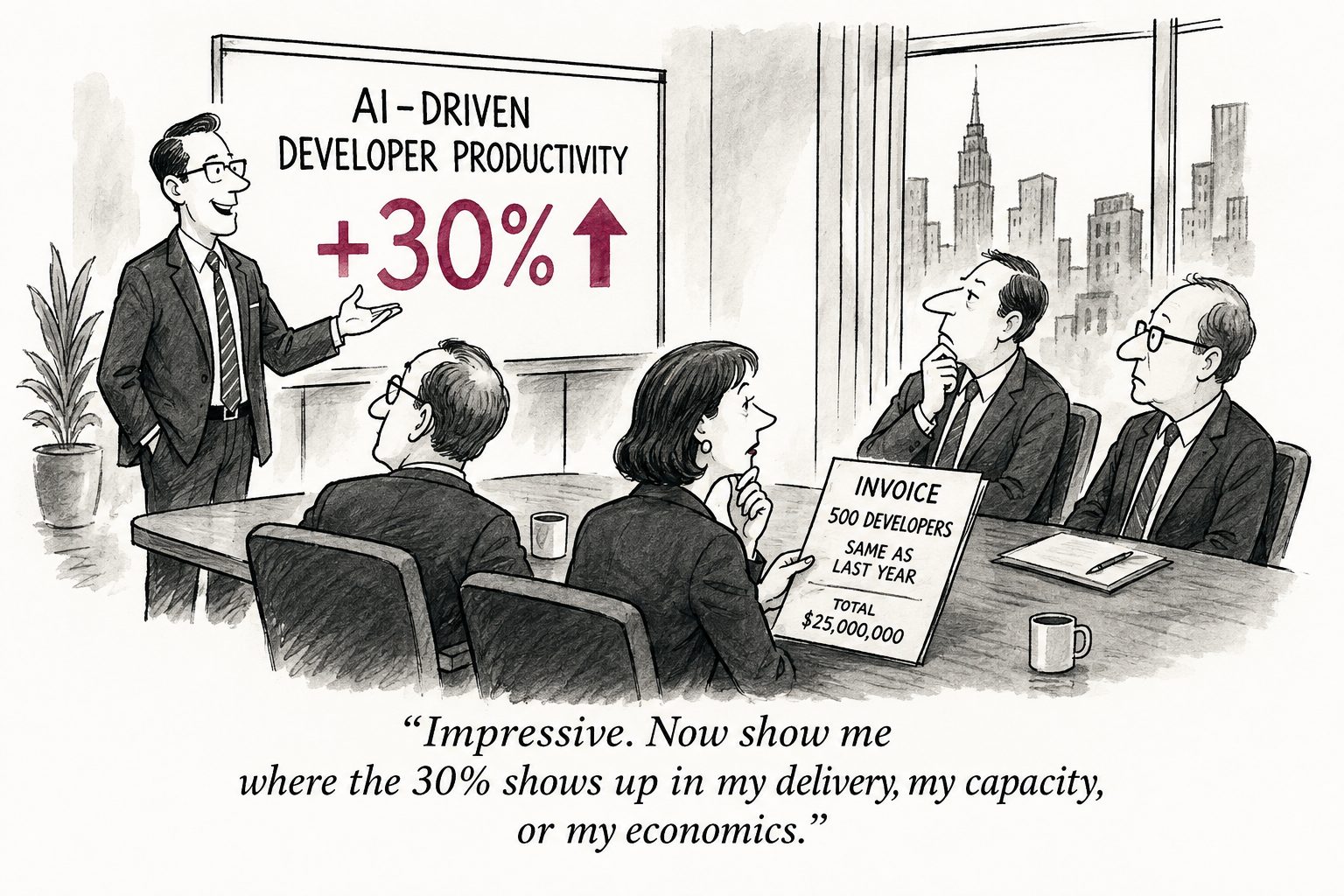
There is a new slide appearing in technology vendor reviews. It usually arrives somewhere after the service-level metrics and before the obligatory roadmap. The title varies, but the message is essentially the same: AI is making our developers more productive. Maybe the number is 20%. Maybe it is 30%. Perhaps it is 40%.
Whatever the number, the natural reaction is positive. After years of hearing about automation, Agile, DevOps, offshore leverage and delivery transformation, here finally appears to be a technology capable of materially changing how much work a software engineer can accomplish.
But there is a question that deserves to come immediately after the applause.
Where did the productivity go?
Imagine a large company with 500 developers supplied by a strategic technology vendor. Before AI, those 500 developers deliver a certain amount of software every year. Then the vendor equips its teams with coding assistants and AI agents. Developers write code faster, generate tests more quickly, troubleshoot problems sooner and automate work that previously consumed hours.
A year later, the vendor reports a 30% improvement in developer productivity. The company still has 500 vendor developers.The invoice looks remarkably familiar. This is where AI productivity stops being a technology story and starts becoming an economic one.
If those 500 developers really are 30% more productive, something should eventually change. The company might receive more software. Projects might finish sooner. The backlog might shrink. Fewer developers might be required. Or the cost of producing a feature might decline.
There is, of course, another possibility. The vendor delivers roughly what it delivered before, continues billing for roughly the same workforce and captures much of the productivity improvement itself.
There is nothing inherently improper about that. Technology providers are investing heavily in AI platforms, tools, training and new delivery methods. They should expect a return on those investments.
But their customers should understand the economics too. And that is where today’s AI productivity conversation gets complicated.
Software isn’t delivered when code is generated. It still has to be reviewed, tested, secured, integrated and deployed. Making developers faster doesn’t automatically make that entire system faster. The 2026 LinearB engineering benchmark, based on more than 8.1 million pull requests across 4,800 teams, illustrates the problem. Its research found larger AI-assisted pull requests and significantly longer pickup times for agentic AI work, along with very different acceptance patterns from traditional developer-created work.
That creates another possibility for our imaginary company. The vendor’s developers really did become 30% more productive. They are producing more code, more quickly. But now the customer’s architects are reviewing more changes. Its security teams are examining more output. Senior engineers are spending additional time determining whether AI-generated code actually belongs in production.
The vendor saved work. The customer gained work.
AI didn’t eliminate the effort. It moved some of it across the contract boundary.
That may become one of the more important distinctions in outsourcing over the next several years. For decades, enterprises have been remarkably good at measuring the cost of technology labor. We know hourly rates. We know offshore ratios. We know staffing pyramids. We can compare the cost of a developer in five countries to two decimal places.
AI may force companies to become equally good at measuring the cost of useful output. A developer who costs $120 an hour isn’t necessarily cheaper than one who costs $145 if the second developer, supported by AI, produces substantially more production-ready software with less rework.
The unit of comparison begins to change.
Not simply: What does the developer cost?
But: What does the outcome cost?
That won’t make rate cards or FTE models disappear. But it should change the conversation around them. And it gives executives a surprisingly simple way to approach all the new AI productivity numbers coming their way. Follow the productivity. If AI adoption increased, did engineering productivity improve? If engineering productivity improved, did delivery improve? If delivery improved, did the economics improve?
Somewhere along that chain, the 30% should become visible. Which brings us back to that vendor-review slide.
AI Productivity: +30%.
It may be completely accurate. Don’t spend the next twenty minutes arguing about how the number was calculated. Ask something more interesting:
“Show me where that 30% appears in my delivery, my capacity or my economics.”
Because AI is going to create a productivity dividend in technology services. The vendor may capture some of it. The customer may capture some of it. The best partnerships will probably find ways for both sides to benefit. The important thing is making sure the answer isn’t determined by accident.
— Two93 | The Five-Minute Vendor Brief