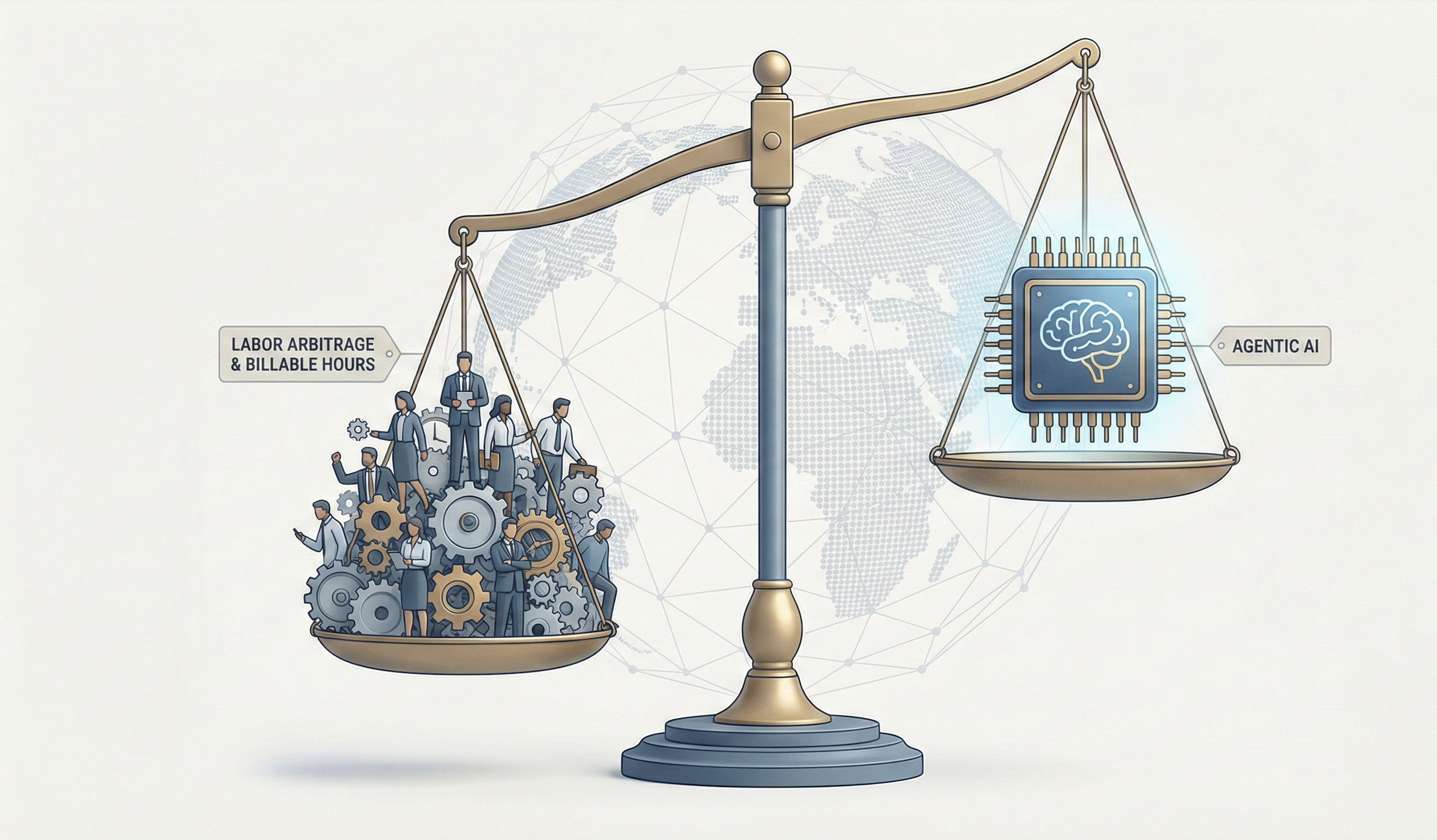
There is a subtle, expensive shift happening in IT outsourcing models. At a glance, your vendors look more productive than ever—completing 10-hour tasks in just 3 hours. But if you don’t understand the “cost behind the cost,” your expected ROI doesn’t just shrink; it vanishes.
When the Machine Costs More Than the Vendor

In many low-cost regions, an offshore resource might cost you $20 per hour. In 2026, a “Reasoning” AI model attempting a complex coding fix can easily burn through $30 worth of tokens in that same hour.
If your vendor is using “brute-force” AI—letting agents loop indefinitely to find a solution—the “Materials” cost (tokens) has officially exceeded the “Labor” cost. If your billing structure doesn’t account for this, you are paying for a “Digital Associate” that is more expensive than the human it replaced.
The Risk of “Invisible” Costs

It’s not necessarily that vendors are being predatory; it’s that the cost structure is now invisible. As IT Leaders, you know that anything invisible is unmanageable. If you continue to pay for “Time & Materials” while the “Materials” are actually high-cost AI tokens, you aren’t capturing value—you are just overpaying for speed.
AI Tokens: The Cost Line Most CIOs Aren’t Watching (Yet)
The “Legal Associate” Analogy

To understand token costs, stop thinking about apps and start thinking about a Digital Legal Associate who bills by the second of focus.
- Traditional Software: You buy the law book. It sits on your shelf. The cost is fixed.
- AI Token Pricing: You pay for every page the Associate has to read and every word they write.
If you ask the Associate, “Is this NDA standard?” they glance at it and charge for a minute of work. But if you tell that Associate, “Before you answer, re-read these 10 previous cases and our 200-page corporate policy,” they will charge you for the hours it takes to process all that information—even if the final answer is still just “Yes.”
AI models don’t charge you for “software”; they charge you for processing power. Every prompt, every document upload, every coding assist, and every autonomous agent loop consumes tokens. Think of tokens as the meter running every time the AI “thinks.”
Real-Life Calculation Examples
Let’s look at how this hits your wallet using 2026 average “Frontier Model” pricing (e.g., $15 per 1 million tokens).
Example A: The “Quick Email”
- Input: You paste a 200-word draft and ask for a tone check.
- Output: The AI gives you a 150-word revision.
- Total Tokens: ~460 tokens.
- Cost: $0.007 (Less than a penny).
- Verdict: AI is drastically cheaper than a human here.
Example B: The “Legal Contract Review”
- Input: You upload a 100-page legal contract (~30,000 words).
- Output: You ask for a 1-page summary (~500 words).
- Total Tokens: ~41,000 tokens.
- Cost: $0.61.
- Verdict: Still cheap, but if you do this 100 times a day, you’re spending $61/day.
Example C: The “Recursive Coder” (The Danger Zone)

- Scenario: You have an AI agent trying to fix a bug in a massive codebase. It “thinks,” writes code, fails, reads the error, and tries again.
- Process: It loops 20 times, reading 5,000 lines of code each time.
- Total Tokens: ~2,000,000 tokens.
- Cost: $30.00.
- Verdict: In 30 minutes, this AI agent just cost you more than a junior developer’s hourly wage.
Why Input Costs More Than Output

Most AI providers charge more for Output (the AI’s words) than Input (your words).
- Input (Reading): $5.00 / million tokens.
- Output (Writing): $15.00 / million tokens.
Why? Because “writing” requires the GPU to do heavy mathematical lifting for every single character it generates, whereas “reading” is a pre-processing step that is computationally lighter.
The “Invisible” Cost: Context

The biggest shock for businesses is Context Persistence. If you are having a long conversation with an AI, the AI has to “re-read” the entire chat history every time you send a new message so it doesn’t forget what you said earlier.
- Message 1: 100 tokens.
- Message 2: 200 tokens (Message 1 + Message 2).
- Message 3: 300 tokens (Messages 1, 2, + 3).
By the time you are on Message 50, you are paying to transmit a small novel’s worth of data just to say “Thanks, looks good!”
The IT leadership Mandate: From FTEs to Outcome Economics
As IT Leaders, you cannot manage what remains invisible. To protect your budget and ensure our organizations actually capture AI’s promised gains, you must pivot our outsourcing strategy:
- Demand Token Transparency: Treat token consumption with the same rigor as cloud egress fees. Ask for “Unit Economics” reports: How many tokens were consumed to produce this deliverable?
- Audit the Production Engine: If a vendor is “AI-First,” your contract should reflect that. You must move away from “Time & Materials” toward Outcome-Based Pricing.
- The “Kill Switch” for Runaway Loops: Ensure your vendors have governance in place to stop expensive, recursive AI “hallucination loops” before they hit your bill.
Final Thought

Outsourcing was built on the cost of a human hour. AI has replaced the “hour” with the “token.” We already learned this lesson with the cloud. You don’t manage AWS by the number of technicians in the data center; you manage it by the compute unit. Outsourcing is hitting its ‘Cloud Moment.’ If you are still measuring FTEs while your vendor is consuming millions of tokens to automate their work, you are effectively paying for a ‘managed service’ while still being billed for the hardware. To win in 2026, you must stop managing the clock and start managing the unit economics of the token